Primary Device
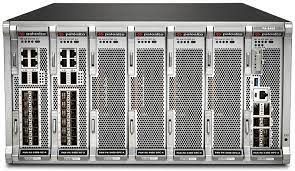
Palo Alto Networks PA-5450
★ 3.4 Value Score
Technical Specifications
- Firewall Throughput: 200 Gbps (App-ID / HTTP appmix)
- Threat Prevention Throughput: 189 Gbps
- IPsec VPN Throughput: 85 Gbps
- Max Sessions: 100 million
- New Sessions/sec: 3.6 million (older datasheet lists 4 million)
- Interfaces: Modular: 1-2 networking cards per system. Each networking card: 4x 100/1000/10G Cu, 12x 1G/10G SFP/SFP+, 2x 40G/100G QSFP28. Requires data processing cards (2 networking cards need at least 2 DPCs)
- Form Factor: 5U rack-mount chassis
Curation Review
- ✔ Pros: Very high throughput for a single chassis (200 Gbps firewall, 189 Gbps threat prevention); Modular design with networking and data processing cards allows capacity to scale; Supports 100M max sessions and 3.6M new sessions per second for large data center and carrier workloads; 85 Gbps IPsec VPN throughput; Redundant AC or DC power and fan options; Full PAN-OS feature set including App-ID, Threat Prevention, and ML-powered security; Interface modes include L2, L3, tap, and virtual wire with 802.1Q VLAN support
- ✘ Cons: High upfront cost, typically around $88,000 to $100,000+ for the base bundle before licensing and support; Performance figures depend on card configuration and test conditions, so real-world results may differ; Requires 5U of rack space and considerable power and cooling, which is excessive for small or mid-size sites; Port counts and bundle contents vary across resellers, so configurations need careful quoting; Subscription licensing for Threat Prevention, URL filtering, and support adds substantial recurring cost; Overkill for branch or SMB deployments that the PA-400 or PA-1400 series would serve better
- Est. Price: $88,320 - $103,010
Compare Against

Ubiquiti Enterprise Fortress Gateway (EFG)
★ 4.9 Value Score
Technical Specifications
- Firewall Throughput: 23.5 Gbps (routing, iPerf3, DHCP WAN)
- Threat Prevention Throughput: 12.5 Gbps (IDS/IPS)
- IPsec VPN Throughput: 580 Mbps (site-to-site, single tunnel)
- Max Sessions: 1,000,000 concurrent
- New Sessions/sec: 71,000 (listed under general capacity; not specific to VPN or IPsec)
- Interfaces: 2x 2.5GbE RJ45, 2x 25G SFP28, 2x 10G SFP+ (some listings show 2x RJ45 + 4x SFP28; verify against the Ubiquiti datasheet)
- Form Factor: 1U rack-mount, dual hot-swappable PSUs
- SSL/TLS Inspection Concurrent Sessions: 10,000 (5,000 recommended under heavy traffic)
- CPU / Memory: 18-core ARM v8.2 @ 2 GHz, 16 GB DDR4
- UniFi Capacity: 500+ UniFi devices, 5,000+ clients
Curation Review
- ✔ Pros: 25G SFP28 and 10G SFP+ uplinks at a gateway price point; 23.5 Gbps routing throughput; 1 million concurrent sessions; 18-core ARM CPU with 16 GB RAM; hot-swappable redundant PSUs; supports 500+ UniFi devices and 5,000+ clients; manages through UniFi Network controller with a single pane of glass
- ✘ Cons: IPsec VPN throughput of 580 Mbps is low for a gateway at this price; IDS/IPS throughput of 12.5 Gbps halves routing performance when threat inspection is enabled; SSL/TLS inspection is limited to about 10,000 concurrent sessions; port configuration differs across listings and should be verified; frequently out of stock at major US retailers, with a $170 memory surcharge at some resellers; no built-in Wi-Fi, so it depends on separate UniFi APs and switches; reviewers cite a steeper learning curve than consumer-grade routers
- Est. Price: $1,999 - $2,892
Popular Comparisons
Palo Alto Networks PA-5450 vs Ubiquiti UniFi Cloud Gateway Fiber
Palo Alto Networks PA-5450 vs Ubiquiti UniFi Dream Machine Pro Max
Palo Alto Networks PA-5450 vs Ubiquiti Cloud Gateway Max
Palo Alto Networks PA-5450 vs Ubiquiti UniFi Cloud Gateway Max (UCG-Max)
Palo Alto Networks PA-5450 vs Ubiquiti Enterprise Fortress Gateway (EFG)