Primary Device
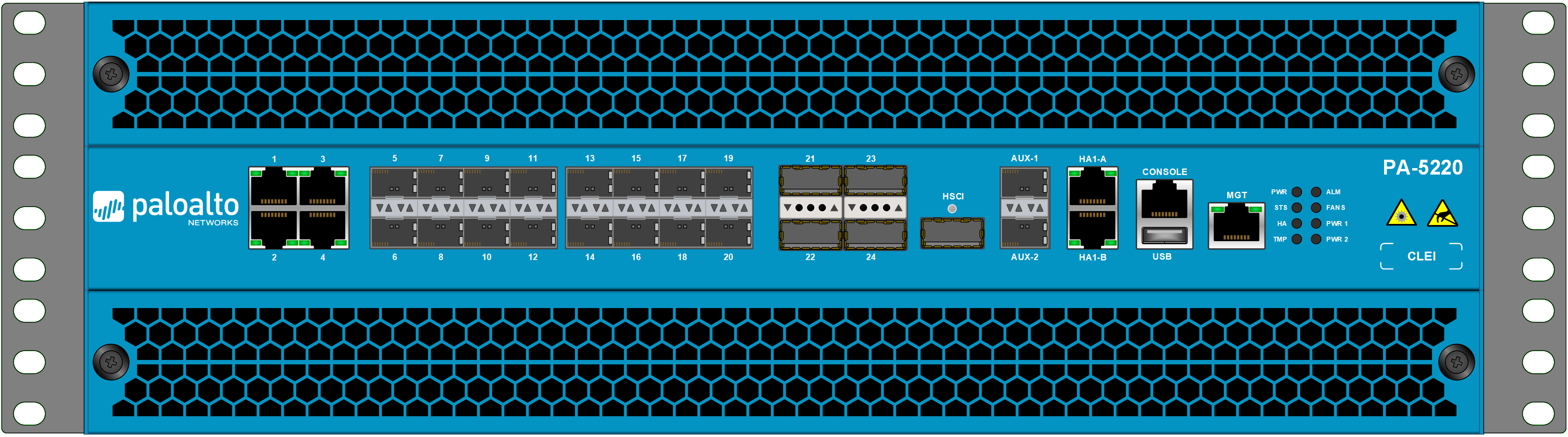
Palo Alto Networks PA-7500
★ 3.4 Value Score
Technical Specifications
- Category: Firewall
- Firewall Throughput: 100 Gbps
- Threat Prevention Throughput: 60 Gbps
- IPsec VPN Throughput: 40 Gbps
- Max Sessions: 200 million
- New Sessions/sec: 1 million
- Interfaces: Modular (up to 12u00d7 40GbE ports or equivalent 10GbE/1GbE)
- Form Factor: 6-slot modular chassis, rack-mounted (19-inch)
- Power Consumption: ~3000W
- Redundancy: Dual power supplies, active-active or active-passive HA
Curation Review
- ✔ Pros: Extreme throughput and performance for large-scale enterprise networks; Modular architecture allows flexible port configurations and future expansion; Advanced multi-layer threat prevention with AI-driven security features; Exceptional session handling capacity suitable for service providers; Comprehensive security ecosystem with integrated threat intelligence and compliance support; Native support for high-speed redundancy and active-active clustering
- ✘ Cons: Prohibitively expensive capital investment with licensing costs adding $20k-50k+ annually; Steep learning curve requiring specialized Palo Alto expertise to configure and manage effectively; Very high power consumption (~3000W) and cooling demands limit deployment flexibility; Large physical footprint and weight require dedicated rack space and infrastructure planning; Complex license entitlements and subscription model can be confusing; Limited justification for most mid-market organizations; vendor lock-in due to proprietary features and licensing structure
- Est. Price: $85,000 - $150,000
Compare Against

Ubiquiti Dream Machine Special Edition (UDM-SE)
★ 4.3 Value Score
Technical Specifications
- Device Type: UniFi Network Appliance / Gateway
- Processor: Quad-core ARM (MediaTek MT7986)
- RAM: 2 GB DDR4
- Storage: 32 GB eMMC + 1 TB HDD (for protect/video)
- Network Interfaces: 1u00d7 WAN (2.5G), 3u00d7 LAN (GbE), 1u00d7 Console (USB)
- Routing Throughput: 3.5 Gbps
- Switching Capacity: 5 Gbps fabric
- Max Concurrent Connections: 100,000+
- VPN Support: IPsec, WireGuard, L2TP
- Security Features: Built-in IPS/IDS, DPI, threat management
- Form Factor: Compact Desktop (1U appliance)
- Power Consumption: 35W typical
- PoE Output: 1u00d7 802.3af (for optional AP)
- Management: UniFi OS + Cloud integration
- Redundancy: Dual WAN capable
Curation Review
- ✔ Pros: All-in-one network appliance with built-in UniFi OS, video storage, and robust security; Excellent value for SMBs combining routing, switching, and threat protection; Includes 1TB HDD for UniFi Protect video surveillance; Silent fanless design or passive cooling; Seamless integration with UniFi ecosystem; Low power consumption (~35W)
- ✘ Cons: Limited to 2.5G WAN uplink (not enterprise-grade 10G); Overkill for very small networks (branch offices with <50 users); Less granular control than dedicated enterprise firewalls (Cisco ASA, Fortinet FortiGate); Storage not user-upgradeable; Noise from HDD if used heavily for video recording; Requires UniFi Cloud account for optimal features
- Est. Price: $299 - $349
Popular Comparisons
Palo Alto Networks PA-7500 vs Fortinet FortiGate 400G
Palo Alto Networks PA-7500 vs Aruba (HPE) Aruba 9106 Gateway
Palo Alto Networks PA-7500 vs Palo Alto Networks ION 3200
Palo Alto Networks PA-7500 vs Palo Alto Networks ION 3200H-C5G-WW
Palo Alto Networks PA-7500 vs Ubiquiti Dream Machine Special Edition (UDM-SE)