Primary Device
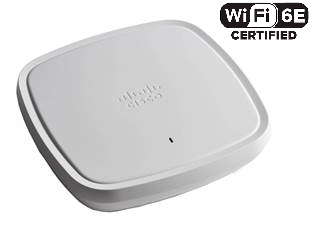
Cisco Catalyst 9136
★ 3.4 Value Score
Technical Specifications
- Wi-Fi Standard: 802.11ax (Wi-Fi 6E), backward compatible with 802.11a/b/g/n/ac
- Spatial Streams (MIMO): 2.4 GHz: 4SS (4x4); 5 GHz: 8SS (8x8); 6 GHz: 4SS (4x4)
- Aggregate Throughput: Up to 10.2 Gbps combined PHY rate (theoretical; 6 GHz 4x4 160 MHz + 5 GHz 8x8 80 MHz + 2.4 GHz 4x4 20 MHz)
- Radios (bands): Tri-radio by default: 2.4 GHz, 5 GHz, 6 GHz, plus a 2.4 GHz BLE 5 IoT radio and a scanning radio. Quad-radio mode with dual 5 GHz (dual 4x4) is a future software upgrade
- Uplink Port Speed: 2x RJ-45 multigigabit (100M/1G/2.5G/5G)
- Max Clients: 1200 total (400 per radio)
- PoE Requirement: 802.3bt (UPOE) for full performance, 47.3 W max; 802.3at 24.4 W with 1x 2.5G and USB disabled; 802.3af 13.95 W for day-0 provisioning only
Curation Review
- ✔ Pros: Tri-radio Wi-Fi 6E design with a dedicated 6 GHz band for less congested high-throughput wireless; 8x8 5 GHz radio and 4x4 radios on 2.4 and 6 GHz; 2x multigigabit uplinks (up to 5G) for higher wired throughput; supports 1200 total clients (400 per radio); integrated Bluetooth 5 (BLE) radio for location and IoT use cases; USB 2.0 and container support for edge applications; managed by Catalyst 9800 controllers or Catalyst 9k switches in SDA mode with Embedded Wireless Controller; 0 to 50°C operating range
- ✘ Cons: Full performance requires 802.3bt (UPOE, 47.3 W) power, so 802.3at or 802.3af switches reduce port speed, disable USB, or limit setup to day-0 provisioning; the 802.3bt power injector (AIR-PWRINJ7) is an extra cost if the switch lacks UPOE; above 40°C the 5 GHz radio drops to 4x4 and the uplink falls to 1G; dual-5 GHz quad-radio mode is a future software upgrade, not available at launch; requires IOS XE 17.7.1 or later and a Catalyst 9800 or EWC controller for centralized management; 10.2 Gbps is a theoretical PHY rate, not measured throughput; no official Cisco list price was found, and reseller prices vary widely
- Est. Price: $2,000 - $3,663
Compare Against

Cisco Catalyst 9166 Series (CW9166)
★ 4.2 Value Score
Technical Specifications
- Wi-Fi Standard: 802.11ax (Wi-Fi 6E, 6 GHz capable); also 802.11a/b/g/n/ac backward compatible
- Spatial Streams (MIMO): 4x4:4 on each of the three client radios (2.4 GHz, 5 GHz, 6 GHz); MU-MIMO and OFDMA supported
- Aggregate Throughput: Up to 7.78 Gbps tri-radio aggregate (maximum over-the-air PHY/chipset frame rate, not per-client throughput)
- Radios (bands): Tri-radio 4x4:4: 2.4 GHz client radio, 5 GHz client radio, 6 GHz client radio; plus tri-band scanning radio (2.4/5/6 GHz) for security/RF analytics and a 2.4 GHz Bluetooth Low Energy radio
- Uplink Port Speed: 1x multigigabit RJ45 (100 Mbps / 1 Gbps / 2.5 Gbps / 5 Gbps BASE-T); also 1 USB 2.0 Type-A port
- Max Clients: Not published in the sources reviewed
- PoE Requirement: 802.3bt (UPOE) 30.5 W for full functionality including USB; 802.3at (PoE+) 25 W supported with reduced functionality and no USB; 802.3af not supported; 54 V DC option available
- Form Factor: Indoor ceiling/wall-mount access point; omnidirectional (CW9166I) or directional (CW9166D1) antenna variants
- Dimensions: 241.3 x 241.3 x 56.9 mm (CW9166I) / 57.9 mm height (CW9166D1); approx. 1.6 kg
- Management: Catalyst 9800 wireless controllers (IOS-XE) or Meraki cloud (CW9166I-MR / CW9166D1-MR SKUs)
Curation Review
- ✔ Pros: Tri-band Wi-Fi 6E with 4x4:4 on every client radio for high-density capacity; dedicated tri-band scanning radio for WIPS, spectrum analysis, and location analytics; multigigabit 5 Gbps uplink on a single RJ45 port; Bluetooth Low Energy radio for beacons and asset tracking; supports both Catalyst 9800 controller and Meraki cloud management; full functionality on 802.3bt PoE with USB output
- ✘ Cons: Full feature set requires 802.3bt (UPOE) power, and 802.3at operation reduces functionality; only one uplink port, so no link aggregation or redundancy; premium price compared with many Wi-Fi 6E APs; maximum client count is not published in available sources; Catalyst (CW9166I-B/-E) and Meraki (CW9166I-MR) SKUs are the same hardware under different management licences, which can confuse purchasing; end-of-sale/end-of-life status is unconfirmed and should be checked with Cisco
- Est. Price: $1,136 - $3,317