Primary Device
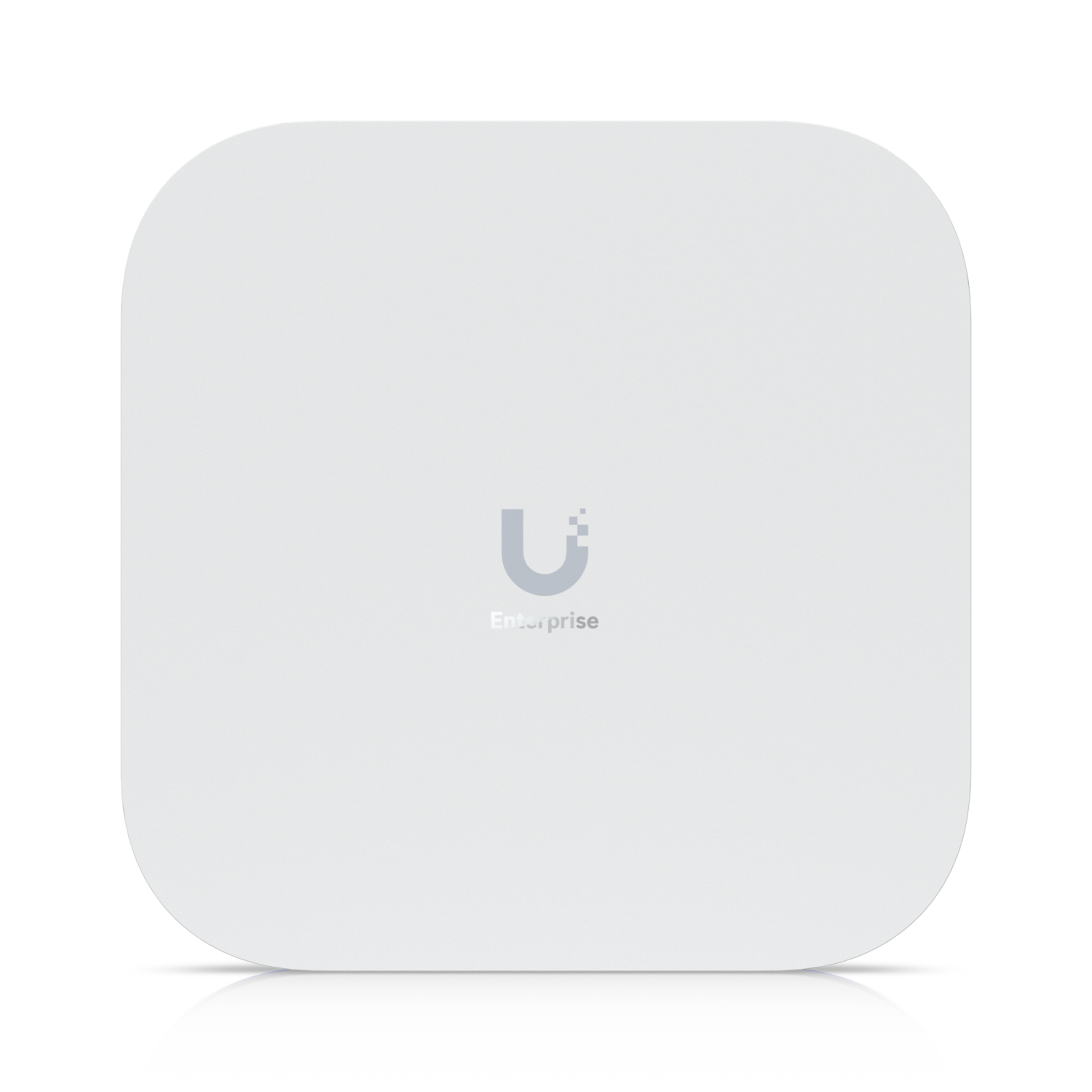
Ubiquiti UniFi Enterprise 7
★ 3.5 Value Score
Technical Specifications
- Wi-Fi Standard: Wi-Fi 7 (802.11be)
- Spatial Streams (MIMO): 10 total: 4x4 on 5 GHz and 6 GHz, 2x2 on 2.4 GHz
- Aggregate Throughput: 20.7 Gbps combined (6 GHz 11.4 Gbps BW320, 5 GHz 8.6 Gbps BW240, 2.4 GHz 688 Mbps BW40; per-band PHY maximums)
- Radios (bands): 3 (tri-band: 2.4 GHz, 5 GHz, 6 GHz)
- Uplink Port Speed: 1x 10GbE RJ45 + 1x 1GbE RJ45 (redundant)
- Max Clients: 1000+
- PoE Requirement: PoE++ (IEEE 802.3bt), up to 43W
- Coverage: 185 mu00b2 (2,000 ftu00b2) indoor
Curation Review
- ✔ Pros: Tri-band Wi-Fi 7 with 10 spatial streams and up to 11.4 Gbps on 6 GHz; 10GbE uplink supports high-throughput wired backhaul; Redundant 1GbE port provides uplink failover; Rated for 1000+ concurrent clients; Managed through UniFi Network with per-user rate limiting and guest traffic isolation; Competitive $499 US list price for a 10-stream tri-band Wi-Fi 7 AP
- ✘ Cons: Requires 802.3bt PoE++ power, so it will not run on standard 802.3at PoE+ switches; Indoor-only design, not suited to outdoor or harsh environments; Rated coverage of about 185 m² per unit means dense deployments need additional APs; 2.4 GHz radio is only 2x2, limiting legacy-band performance; Full enterprise feature set requires a UniFi Network controller (self-hosted or UniFi OS console)
- Est. Price: $499
Compare Against

Cisco Catalyst 9178i
★ 4.3 Value Score
Technical Specifications
- Wi-Fi Standard: Wi-Fi 7 (802.11be)
- Spatial Streams (MIMO): 4x4 MU-MIMO per client-serving radio (4 spatial streams per radio)
- Aggregate Throughput: 24 Gbps aggregate (concurrent 2.4 GHz, 5 GHz and 6 GHz radios)
- Radios (bands): 4 client-serving radios: tri-band 2.4 GHz / 5 GHz / 6 GHz with a 4th radio (quad-radio design)
- Uplink Port Speed: 2x 10 Gbps mGig ports (multi-gigabit Ethernet)
- Max Clients: 1200 (400 per radio)
- PoE Requirement: 802.3bt (PoE++) required for full operation; 802.3at/af supports reduced functionality; draws approx. 30-52 W
Curation Review
- ✔ Pros: Wi-Fi 7 with tri-band 2.4/5/6 GHz and 4x4 MU-MIMO on every radio; 24 Gbps aggregate throughput for high-density environments; dual 10 Gbps mGig uplinks avoid a 1 Gbps bottleneck; rated for up to 1200 clients; supports 802.3bt PoE on the mGig ports with at/af fallback; manageable from Catalyst 9800 WLC/Catalyst Center or Meraki cloud depending on SKU
- ✘ Cons: Requires 802.3bt PoE for full functionality, which raises switch and injector cost; needs Catalyst 9800 controller running IOS XE 17.15.2 or later for the Catalyst SKU; Wi-Fi 7 benefits need Wi-Fi 7 clients to be realized; list pricing varies widely by reseller and SKU (CFG vs Global vs RTG), and reseller spec figures differ in places; cloud-managed (Meraki) deployment requires separate licensing; premium cost compared with Wi-Fi 6E alternatives
- Est. Price: $1,681 - $2,996