Primary Device
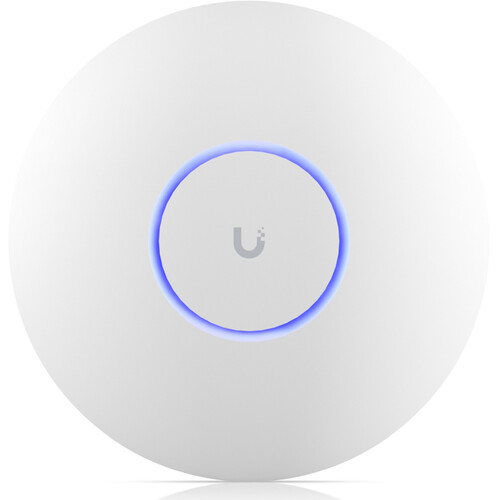
Ubiquiti UniFi U7 Pro
★ 5.0 Value Score
Technical Specifications
- Wi-Fi Standard: Wi-Fi 7 (802.11be)
- Spatial Streams (MIMO): 6 total (2x2 DL/UL MU-MIMO per band: 2.4 GHz, 5 GHz, 6 GHz)
- Aggregate Throughput: Ubiquiti lists per-band maximums: 6 GHz 5.8 Gbps (BW320), 5 GHz 4.3 Gbps (BW240), 2.4 GHz 688 Mbps (BW40); retailers cite a combined figure of about 9.3 Gbps (marketing sum, not a single-link rate)
- Radios (bands): 3 radios, tri-band: 2.4 GHz, 5 GHz, 6 GHz; up to 8 BSSIDs per radio
- Uplink Port Speed: 1x 1/2.5 GbE RJ45
- Max Clients: 300+
- PoE Requirement: 802.3at PoE+ (44-57V DC input); max power consumption 21 W; PoE injector/switch not included in most listings
Curation Review
- ✔ Pros: Wi-Fi 7 tri-band radio with 6 GHz support; 2.5 GbE uplink exceeds standard 1 GbE backhaul needs; Designed for UniFi controller management with centralized config, monitoring, and firmware updates; Low-profile ceiling or wall mount with included Pro Mount; Lower price than the U7 Pro Max and U7 Pro XGS, which makes it a good value for Wi-Fi 7 deployments; Supports 300+ clients per unit
- ✘ Cons: Only one 2.5 GbE port, so no link aggregation or secondary uplink; Requires PoE+ power (no included PoE injector in most retail bundles); Uses 2x2 MU-MIMO per band, so it has fewer streams than higher-end Wi-Fi 7 APs; Requires UniFi Network application version 8.0.28 or later for full feature support; Limited to 1 radio per band with no dedicated security/scanning radio; Aggregate throughput marketing figures overstate what a single client can achieve in practice
- Est. Price: $189 - $237
Compare Against

Cisco Catalyst 9178I (CW9178I)
★ 0.0 Value Score
Technical Specifications
- Wi-Fi Standard: 802.11be (Wi-Fi 7); also 802.11ax/ac/n and a/b/g
- Spatial Streams (MIMO): 4x4:4SS on each client radio (2.4 GHz, 5 GHz, 6 GHz); quad-radio mode adds a second 4x4 5 GHz radio
- Aggregate Throughput: Up to 24 Gbps PHY aggregate in quad-radio mode (Cisco datasheet; Meraki lists 24 Gbps as a chipset maximum that may exceed 802.11be operation); up to 18 Gbps in tri-radio mode
- Radios (bands): Default tri-radio: 2.4 GHz 4x4 (20 MHz), 5 GHz 4x4 (160 MHz), 6 GHz 4x4 (320 MHz). Quad-radio via Flexible Radio Assignment adds a second 5 GHz radio. Also: dedicated tri-band scanning radio (Air Marshal WIDS/WIPS), integrated IoT radio, BLE 5.3 (upgradable to 6.0), integrated UWB radio (listed on Cisco datasheet; ordering line references UWB), built-in GNSS/GPS
- Uplink Port Speed: 2x multigigabit RJ-45 (dual 10G mGig): 100M/1G/2.5G/5G/10G; Cat6/Cat6A required for 10 Gbps
- Max Clients: Not stated in Cisco or Meraki datasheets
- PoE Requirement: 802.3bt (UPOE, Class 6, 47 W max) for full operation; 802.3at (25.5 W) supported with reduced functionality; 802.3af (13.95 W) for staging only; optional Cisco Power Injector CW-INJ-8; USB 2.0 at 9 W
- Layer (L2/L3): Not applicable (wireless access point)
- Form Factor: Indoor AP, 9.9 x 9.9 x 2.0 in (251 x 251 x 51 mm) excluding mount plate/brackets, 4.1 lb (1.87 kg); desktop, ceiling, and wall mountable
- Datasheet Updated: August 10, 2026 (Cisco)
Curation Review
- ✔ Pros: Wi-Fi 7 (802.11be) with 4x4 on all client radios; Tri-band with optional quad-radio mode for extra 5 GHz capacity; Dedicated scanning radio for WIDS/WIPS and RF visibility without sacrificing client radios; Dual 10G mGig uplinks with port and power redundancy; Integrated IoT, BLE, GNSS, and UWB radios in one unit; Supports both Catalyst Wireless LAN Controller and Meraki cloud deployments
- ✘ Cons: Requires 802.3bt (UPOE) PoE for full operation, so many legacy switches cannot power it fully; Full 10G uplink needs Cat6/Cat6A cabling; Aggregate 24 Gbps figure is a PHY maximum rather than real-world throughput; Embedded wireless controller (EWC) mode is not supported; Max client count is not published in the datasheets; Higher price than Wi-Fi 6E alternatives, with list price around $3,896 and street prices of about $2,190 to $2,620 depending on retailer and SKU (-CFG vs -RTG)
- Est. Price: $2,188 - $2,619