Primary Device
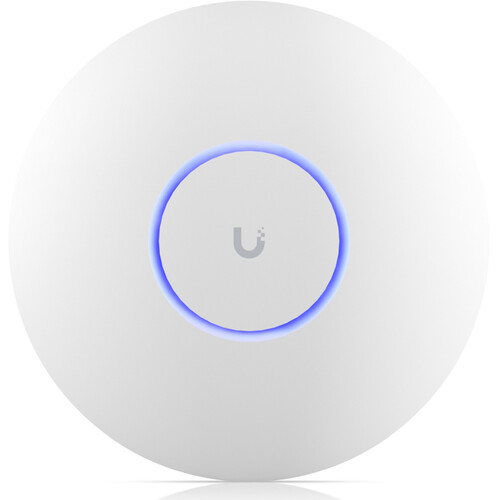
Ubiquiti UniFi U7 Pro
★ 5.0 Value Score
Technical Specifications
- Wi-Fi Standard: Wi-Fi 7 (802.11be), tri-band
- Spatial Streams (MIMO): 6 total; 2x2 MIMO per band (2.4 GHz, 5 GHz, 6 GHz)
- Aggregate Throughput: 9.3 Gbps (per-band: 2.4 GHz 688 Mbps, 5 GHz 2882 Mbps, 6 GHz 5765 Mbps)
- Radios (bands): 3 radios: 2.4 GHz, 5 GHz, 6 GHz
- Uplink Port Speed: 1x 2.5GbE RJ45 (1G/2.5G auto-negotiation)
- Max Clients: 300+ connected devices
- PoE Requirement: 802.3at PoE+ (44-57V DC input), approx. 21 W typical draw
Curation Review
- ✔ Pros: Tri-band Wi-Fi 7 with 6 GHz support at a low entry price; 2.5GbE uplink lets it outrun standard gigabit wired backhaul; single-cable PoE+ power simplifies deployment; 300+ client capacity suits small-to-medium offices and homes; wall and ceiling mounts included; 2-year warranty; managed centrally through the UniFi controller ecosystem
- ✘ Cons: Only 2x2 MIMO per band, so it trails 4x4-class Wi-Fi 7 APs and the U7 Pro Max; no 10GbE uplink for high-throughput environments; requires a UniFi controller (UniFi OS or Network app) for full management; PoE+ budget leaves no headroom for power-hungry add-ons; street prices often sit above the $189 MSRP; no built-in PoE injector, so a PoE+ switch or injector is required
- Est. Price: $179 - $237
Compare Against

Cisco Catalyst 9176I (CW9176I-CFG)
★ 0.0 Value Score
Technical Specifications
- Wi-Fi Standard: IEEE 802.11be (Wi-Fi 7), backward compatible with 802.11a/b/g/n/ac/ax
- Spatial Streams (MIMO): 4x4 MU-MIMO (4 spatial streams) on 2.4 GHz, 5 GHz and 6 GHz client radios
- Aggregate Throughput: 18 Gbps theoretical PHY (tri-radio, 802.11be); sustained client throughput not published by Cisco
- Radios (bands): Tri-band client radios: 2.4 GHz (20 MHz, 688 Mbps PHY), 5 GHz (up to 160 MHz, 5,700-5,764 Mbps PHY), 6 GHz (up to 320 MHz, 11,520-11,529 Mbps PHY); plus dedicated tri-band scanning radio, 2.4 GHz IoT radio, UWB, GNSS and BLE 5.3 radio
- Uplink Port Speed: 1x multigigabit RJ-45 (100M/1G/2.5G/5G/10G BASE-T); 10 Gbps requires Cat6/Cat6A cabling
- Max Clients: Not stated in Cisco datasheet
- PoE Requirement: 802.3bt (UPOE) recommended for full operation (39 W Class 5 in power table; datasheet text references Class 6 / 60 W); 802.3at supports 2.5G with 2.4 GHz at 2x2; 802.3af for low-power staging only with radios off
- Antennas: Internal omnidirectional; peak gain 5 dBi (2.4 GHz), 6 dBi (5 GHz and 6 GHz)
- Other Ports: 1x management console RJ-45 (115,200 bps default); 1x USB 2.0 (9 W, 802.3bt only); Kensington lock slot
- Dimensions / Weight: 9.5 x 9.5 x 2.0 in (241 x 241 x 51 mm) excluding mount plate / 3.4 lb (1.56 kg)
- Management: Catalyst 9800 WLC or Catalyst Center (IOS XE 17.15.2 or later); Meraki cloud management in Meraki SKU variant
- Price Note: Retailer listings only; no official Cisco list price found. Low end is a sale price for the CFG SKU; high end is a US MSRP-style figure for a related listing
Curation Review
- ✔ Pros: Tri-band Wi-Fi 7 with 4x4 MU-MIMO on all client radios and 320 MHz channels on 6 GHz; Dedicated tri-band scanning radio for continuous RF monitoring and security; Multigigabit uplink up to 10 Gbps, avoiding 1G bottlenecks for high-density traffic; Integrated IoT, UWB, GNSS and BLE 5.3 radios for location and sensor use cases; Flexible management through Catalyst 9800 WLC/Catalyst Center or Meraki cloud, depending on SKU
- ✘ Cons: Max client count is not published in the datasheet, making capacity planning harder; The 18 Gbps aggregate is a theoretical PHY figure, not real-world throughput; 10 Gbps uplink requires Cat6/Cat6A cabling and 802.3bt PoE for full performance; Power requirements are inconsistent across Cisco's documents (Class 5 at 39 W vs Class 6 at 60 W), so the injector or switch must be verified; Premium price compared with Wi-Fi 6E alternatives, with wide retailer price variance and confusing SKU suffixes (CFG, RTG, Meraki variants)
- Est. Price: $1,183 - $2,507