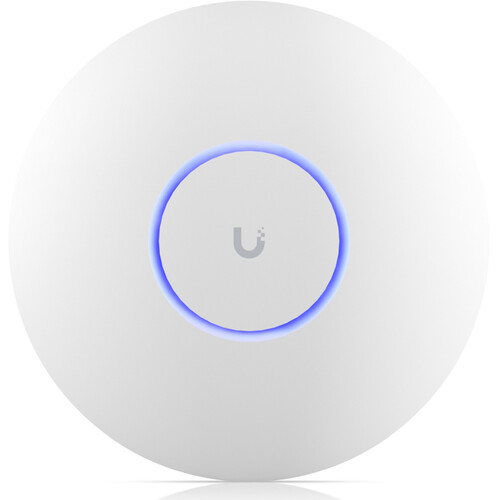
Uplink Port Speed: 1x 2.5GbE RJ45 (1G/2.5G auto-negotiation)
Max Clients: 300+ connected devices
PoE Requirement: 802.3at PoE+ (44-57V DC input), approx. 21 W typical draw
Curation Review
✔ Pros:Tri-band Wi-Fi 7 with 6 GHz support at a low entry price; 2.5GbE uplink lets it outrun standard gigabit wired backhaul; single-cable PoE+ power simplifies deployment; 300+ client capacity suits small-to-medium offices and homes; wall and ceiling mounts included; 2-year warranty; managed centrally through the UniFi controller ecosystem
✘ Cons:Only 2x2 MIMO per band, so it trails 4x4-class Wi-Fi 7 APs and the U7 Pro Max; no 10GbE uplink for high-throughput environments; requires a UniFi controller (UniFi OS or Network app) for full management; PoE+ budget leaves no headroom for power-hungry add-ons; street prices often sit above the $189 MSRP; no built-in PoE injector, so a PoE+ switch or injector is required
Est. Price:
$179 - $237
Compare Against
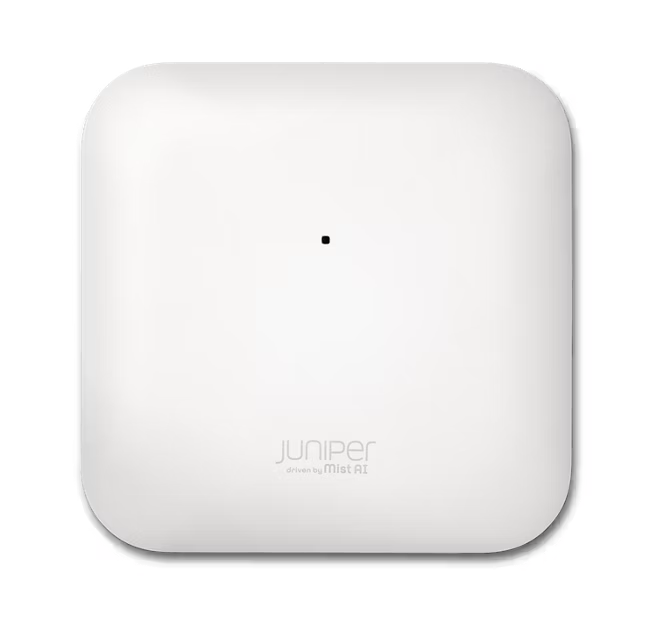
Juniper Networks AP45
★ 3.4 Value Score
Technical Specifications
Wi-Fi Standard: Wi-Fi 6E (802.11ax); backward compatible with 802.11a/b/g/n/ac
Spatial Streams (MIMO): 4x4:4 802.11ax on each data radio (2.4, 5, and 6 GHz); SU-MIMO and MU-MIMO. 802.3at power limits 4x4 to two data radios at once
Aggregate Throughput: 9.6 Gbps total PHY (6 GHz: 4.8 Gbps, 5 GHz: 2.4 Gbps, 2.4 GHz: 1.148 Gbps); some resellers list 8.15 Gbps
Radios (bands): 4 radios: 2.4 GHz, 5 GHz, and 6 GHz data radios plus a dedicated 2.4/5/6 GHz scanning radio
Uplink Port Speed: 2 Ethernet ports: 1x 5GbE multigigabit (802.3bt PoE) and 1x 1GbE
Max Clients: 512 per radio
PoE Requirement: 802.3bt (29.3 W for full functionality); 802.3at operates with reduced radio configuration
Bluetooth / IoT: Virtual BLE in 6 GHz, Bluetooth 5.0, directional and omnidirectional BLE antenna array, IoT support
✔ Pros:Tri-band Wi-Fi 6E with 4x4 MU-MIMO on every data radio; Dedicated scanning radio for RF monitoring and security; High aggregate PHY rate of 9.6 Gbps; 512 clients per radio suits high-density venues; 5GbE multigigabit uplink supports multi-gig backhaul; Virtual BLE and IoT support without a separate BLE radio; Cloud management and AI-driven operations through Juniper Mist
✘ Cons:Full functionality requires 802.3bt PoE, so 802.3at switches reduce radio capability; Premium price relative to many Wi-Fi 6E access points; Cloud management depends on a Juniper Mist subscription, and the 5-year bundles add substantial cost; Indoor-only design with no external-antenna option on the base AP45; Regional SKUs (such as AP45-US) limit deployment to specific regulatory domains; Juniper does not publish an official USD MSRP, so street prices vary widely by reseller and bundle