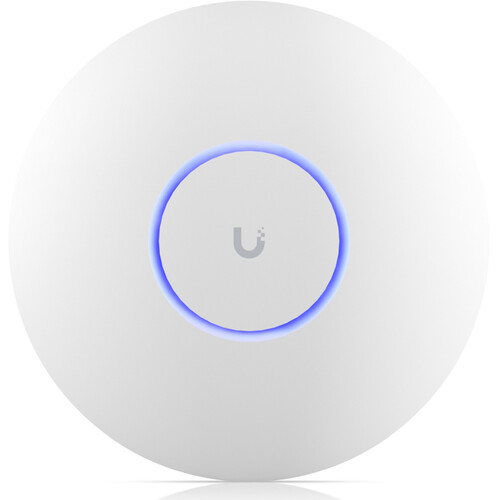
Uplink Port Speed: 1x 2.5GbE RJ45 (1G/2.5G auto-negotiation)
Max Clients: 300+ connected devices
PoE Requirement: 802.3at PoE+ (44-57V DC input), approx. 21 W typical draw
Curation Review
✔ Pros:Tri-band Wi-Fi 7 with 6 GHz support at a low entry price; 2.5GbE uplink lets it outrun standard gigabit wired backhaul; single-cable PoE+ power simplifies deployment; 300+ client capacity suits small-to-medium offices and homes; wall and ceiling mounts included; 2-year warranty; managed centrally through the UniFi controller ecosystem
✘ Cons:Only 2x2 MIMO per band, so it trails 4x4-class Wi-Fi 7 APs and the U7 Pro Max; no 10GbE uplink for high-throughput environments; requires a UniFi controller (UniFi OS or Network app) for full management; PoE+ budget leaves no headroom for power-hungry add-ons; street prices often sit above the $189 MSRP; no built-in PoE injector, so a PoE+ switch or injector is required
Est. Price:
$179 - $237
Compare Against
Cisco Catalyst CW9176I
★ 3.4 Value Score
Technical Specifications
Wi-Fi Standard: 802.11a/b/g/n/ac/ax/be (Wi-Fi 7), cloud-managed 4x4:4 802.11be AP
Spatial Streams (MIMO): 4x4 MIMO (4 spatial streams) on 2.4 GHz, 5 GHz and 6 GHz client radios
Aggregate Throughput: 18 Gbps tri-radio aggregate (vendor maximum; 6 GHz up to 11,520 Mbps, 5 GHz up to 5,700 Mbps, 2.4 GHz up to 688 Mbps; the datasheet notes this may exceed what 802.11be operation allows)
Radios (bands): 2.4 GHz 802.11b/g/n/ax/be client radio; 5 GHz 802.11a/n/ac/ax/be client radio (flex slot can alternatively run 2.4 GHz); 6 GHz 802.11ax/be client radio; 2.4 GHz IoT radio; tri-band Air Marshal WIDS/WIPS, spectrum and location scanning radio; BLE 5.3 (upgradable to 6.0); all radios operate concurrently
Uplink Port Speed: 1x RJ45 multigigabit port, 100M/1G/2.5G/5G/10G BASE-T (datasheet lists the lowest speed inconsistently); plus console port and USB 2.0 (9W)
Max Clients: Not stated in the datasheet or any source found
PoE Requirement: 802.3bt (Class 5, 39W max) for full operation at 10G with USB enabled; 802.3at (25.5W) limits to 2.5G with 2x2 on 2.4 GHz; 802.3af (13.95W) runs in low-power mode at 1G. Recommended injector CW-INJ-8; supported MA-INJ-6 and AIR-PWRINJ-7
Curation Review
✔ Pros:Wi-Fi 7 (802.11be) tri-band 4x4 radios with all five radios operating concurrently; Dedicated tri-band Air Marshal scanning radio for WIPS/WIDS and spectrum analysis without losing client service; Multigigabit uplink up to 10G BASE-T for high-throughput backhaul; Integrated BLE 5.3 and 2.4 GHz IoT radio for IoT/location use cases; Flexible management: cloud (Meraki) or on-premises via Catalyst 9800 WLC and Catalyst Center
✘ Cons:Full performance requires 802.3bt (UPOE) power, so many older PoE+ switches will limit it to 2.5G and 2x2 on 2.4 GHz; Vendor throughput figures conflict across sources and the 18 Gbps aggregate is a theoretical radio-chipset maximum, not real-world capacity; Max client count is not published in the sources reviewed; Premium pricing relative to Wi-Fi 6E APs, with resellers quoting widely varying prices; Requires a Cisco subscription or Meraki license, and the power cord is sold separately; Datasheet is Meraki-branded, so Catalyst-branded SKU details (-CFG vs -RTG) should be confirmed against Cisco's official Catalyst datasheet