Primary Device

Ubiquiti UniFi Cloud Gateway Fiber
★ 5.0 Value Score
Technical Specifications
- Firewall Throughput: Not published by Ubiquiti; 5 Gbps IDS/IPS-secured routing throughput is the only headline figure (reviewer and retailer listings)
- Threat Prevention Throughput: 5 Gbps IDS/IPS
- IPsec VPN Throughput: Not published
- Max Sessions: Not published; 500+ simultaneous users and 4,000-entry MAC address table
- New Sessions/sec: Not published
- Interfaces: 2x 10G SFP+; 1x 10GbE RJ45 (10G/2.5G/1G); 4x 2.5GbE RJ45 (2.5G/1G/100M/10M); 2 of the 6 WAN-capable ports are default WAN (1x 10G SFP+ and 1x 10GbE RJ45), with the other ports selectable as WAN
- Form Factor: Compact desktop; 212.8 x 127.6 x 30 mm; 675 g without SSD
- CPU / RAM: Quad-core ARM Cortex-A73 at 2.2 GHz / 3 GB RAM
- Storage: Optional NVMe SSD up to 2 TB (NVR storage)
- PoE Budget: 30W total from one PoE+ port (port 4)
- Max Power Consumption: 29.4W excluding PoE output
Curation Review
- ✔ Pros: Lowest-cost Ubiquiti gateway with 5 Gbps IDS/IPS, rated above the UDM-SE's 3.5 Gbps at a lower launch price ($279 MSRP vs. $499); Multi-gig flexibility with 10GBASE-T, dual SFP+ and four 2.5GbE ports; Compact desktop design with optional NVMe storage for UniFi Protect/NVR use; Supports site-to-site VPN plus OpenVPN, WireGuard and L2TP server functions, with integrated PoE+ for one device; Managed through the UniFi Network controller with 500+ simultaneous user capacity
- ✘ Cons: No official routing, IPsec or WireGuard throughput figures published by Ubiquiti; community WireGuard numbers (around 400-500 Mbps) are unverified; Only one PoE+ output port (30W total) versus eight PoE ports on the UDM-SE; Lower device and user capacity and less storage expansion than the UDM-SE; No published IPsec tunnel or concurrent session limits; Reseller prices now often run above the launch MSRP (about $320-$346 USD at US resellers)
- Est. Price: $279 - $346
Compare Against
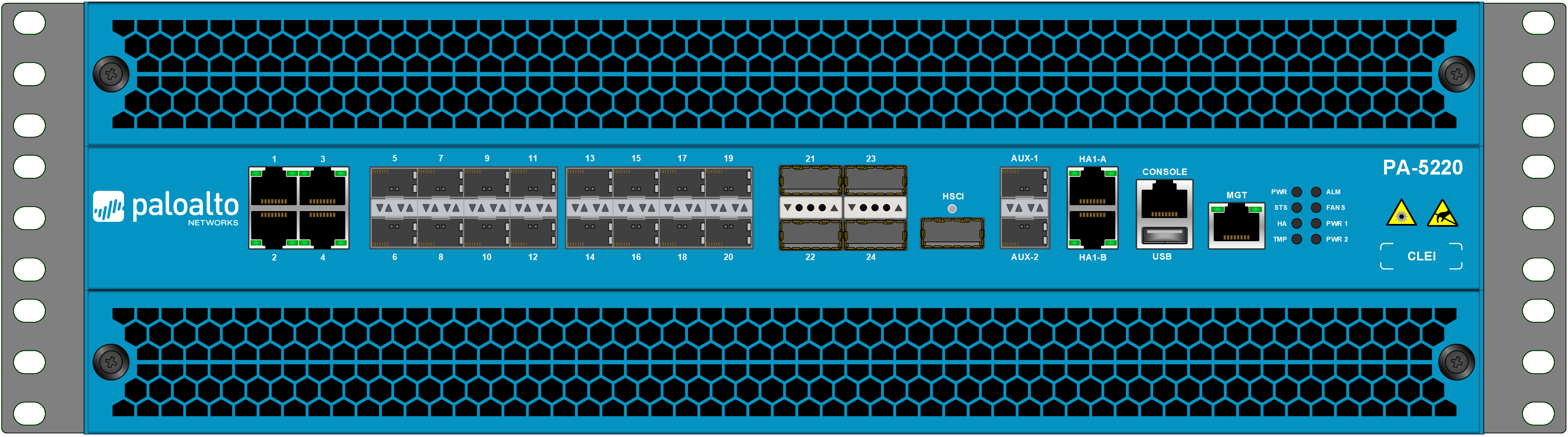
Palo Alto Networks PA-7500
★ 3.2 Value Score
Technical Specifications
- Firewall Throughput: 1,500 Gbps (App-ID enabled, Palo Alto spec sheet; resellers agree)
- Threat Prevention Throughput: 1,440 Gbps (Palo Alto spec sheet; resellers agree)
- IPsec VPN Throughput: 407 Gbps per Palo Alto spec sheet as reported in search summaries; a reseller lists 850 Gbps. Unverified, because the PDF could not be parsed
- Max Sessions: 440,000,000 concurrent sessions
- New Sessions/sec: 7,200,000
- Interfaces: Modular: nine card slots holding MPC/NPC/DPC front-slot cards plus SFC switch fabric cards. Port counts depend on installed cards; not verified
- Form Factor: 14RU chassis, 24.4 in H x 31.0 in D x 17.4 in W, up to 460 lb depending on configuration; 10 hot-swap AC or DC power supplies
Curation Review
- ✔ Pros: Very high App-ID and threat prevention throughput in the 1.4 to 1.5 Tbps class, aimed at large data centers and carriers; Modular, field-replaceable card architecture (DPC, NPC, MPC, SFC) allows capacity to be scaled by adding cards; Redundant hot-swappable power supplies and fans suit high-availability deployments; Very high concurrent session capacity (440M) and 7.2M new sessions per second; Part of the ML-powered Palo Alto Networks NGFW platform with the full PAN-OS feature set
- ✘ Cons: Very high acquisition cost: a single DPC-A card alone is listed around $272,000 to $302,000 at one reseller, and the full chassis is not publicly priced, so price_max is an estimate rather than a quote; Large footprint at 14RU and up to 460 lb, requiring data-center rack space, cooling, and floor loading planning; Heavy power and cooling requirements; Spec figures conflict across sources (IPsec VPN in particular), so verify against the official Palo Alto Networks datasheet before procurement; Official datasheet and docs pages were not reachable in this research, so some figures come from reseller and third-party copies; Port configuration is fully dependent on the cards ordered, which adds complexity to quoting and ordering; Overkill for most enterprise sites compared with smaller PA-Series models
- Est. Price: $272,250 - $1,500,000
Popular Comparisons
Ubiquiti UniFi Cloud Gateway Fiber vs Ubiquiti UniFi Dream Machine Pro Max
Ubiquiti UniFi Cloud Gateway Fiber vs Ubiquiti Cloud Gateway Max
Ubiquiti UniFi Cloud Gateway Fiber vs Ubiquiti UniFi Cloud Gateway Max (UCG-Max)
Ubiquiti UniFi Cloud Gateway Fiber vs Ubiquiti Enterprise Fortress Gateway (EFG)
Ubiquiti UniFi Cloud Gateway Fiber vs Fortinet FortiGate 400G