Primary Device

Ubiquiti UniFi Cloud Gateway Max (UCG-Max)
★ 4.9 Value Score
Technical Specifications
- Firewall Throughput: Not published by Ubiquiti in the sources reviewed
- Threat Prevention Throughput: 2.3 Gbps IDS/IPS per Ubiquiti spec page (older listings show 1.5 Gbps)
- IPsec VPN Throughput: Not published by Ubiquiti; third-party reviews report about 800-1,000 Mbps for WireGuard and 300-400 Mbps for OpenVPN
- Max Sessions: Not published in the sources reviewed
- New Sessions/sec: Not published in the sources reviewed
- Interfaces: 1x 2.5GbE RJ45 WAN, 4x GbE RJ45 LAN (one LAN port can be reconfigured as a second WAN for multi-WAN)
- Form Factor: Compact desktop; UCG-Max-NS variant includes 512GB NVMe storage
Curation Review
- ✔ Pros: Low entry price at $199 MSRP; Compact desktop form factor; Five-port layout with multi-WAN support via a reconfigurable LAN port; Runs UniFi OS with integrated IDS/IPS, site-to-site and remote VPN options (IPsec, WireGuard, OpenVPN, L2TP); Manages 30+ UniFi devices and 300+ clients per Ubiquiti listing
- ✘ Cons: Routing and IPS throughput (2.3 Gbps) is modest for multi-gigabit WANs with inspection enabled; Published throughput figures conflict across sources (1.5 vs 2.3 Gbps IPS, varying VPN numbers); Only one 2.5GbE port, with the remaining ports at 1GbE; Vendor does not publish IPsec tunnel, session, or new-connection limits; Some resellers list prices well above MSRP (one US listing at $394.79)
- Est. Price: $199 - $279
Compare Against
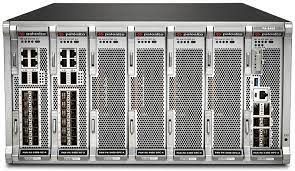
Palo Alto Networks PA-5450
★ 3.4 Value Score
Technical Specifications
- Firewall Throughput: 200 Gbps (App-ID / HTTP appmix)
- Threat Prevention Throughput: 189 Gbps
- IPsec VPN Throughput: 85 Gbps
- Max Sessions: 100 million
- New Sessions/sec: 3.6 million (older datasheet lists 4 million)
- Interfaces: Modular: 1-2 networking cards per system. Each networking card: 4x 100/1000/10G Cu, 12x 1G/10G SFP/SFP+, 2x 40G/100G QSFP28. Requires data processing cards (2 networking cards need at least 2 DPCs)
- Form Factor: 5U rack-mount chassis
Curation Review
- ✔ Pros: Very high throughput for a single chassis (200 Gbps firewall, 189 Gbps threat prevention); Modular design with networking and data processing cards allows capacity to scale; Supports 100M max sessions and 3.6M new sessions per second for large data center and carrier workloads; 85 Gbps IPsec VPN throughput; Redundant AC or DC power and fan options; Full PAN-OS feature set including App-ID, Threat Prevention, and ML-powered security; Interface modes include L2, L3, tap, and virtual wire with 802.1Q VLAN support
- ✘ Cons: High upfront cost, typically around $88,000 to $100,000+ for the base bundle before licensing and support; Performance figures depend on card configuration and test conditions, so real-world results may differ; Requires 5U of rack space and considerable power and cooling, which is excessive for small or mid-size sites; Port counts and bundle contents vary across resellers, so configurations need careful quoting; Subscription licensing for Threat Prevention, URL filtering, and support adds substantial recurring cost; Overkill for branch or SMB deployments that the PA-400 or PA-1400 series would serve better
- Est. Price: $88,320 - $103,010
Popular Comparisons
Ubiquiti UniFi Cloud Gateway Max (UCG-Max) vs Ubiquiti UniFi Cloud Gateway Fiber
Ubiquiti UniFi Cloud Gateway Max (UCG-Max) vs Ubiquiti UniFi Dream Machine Pro Max
Ubiquiti UniFi Cloud Gateway Max (UCG-Max) vs Ubiquiti Cloud Gateway Max
Ubiquiti UniFi Cloud Gateway Max (UCG-Max) vs Ubiquiti Enterprise Fortress Gateway (EFG)
Ubiquiti UniFi Cloud Gateway Max (UCG-Max) vs Fortinet FortiGate 400G