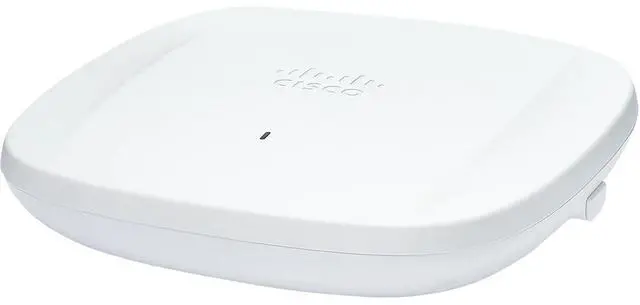
Aggregate Throughput: Up to 24 Gbps PHY (quad-radio mode); up to 18-23 Gbps PHY (tri-radio mode); per-band 802.11be rates not published
Radios (bands): Tri-band 2.4 GHz / 5 GHz / 6 GHz; runs in quad or tri radio mode; channel widths 6 GHz 20-320 MHz, 5 GHz 20-160 MHz, 2.4 GHz 20 MHz
Uplink Port Speed: 2x RJ-45 multigigabit ports at 100M/1G/2.5G/5G/10G (Cat 6/6A required for 10G; Cat 5e up to 5G); RJ-45 console port at 115200 bps
Max Clients: Not published by Cisco
PoE Requirement: 802.3bt UPOE Class 6 (47W max, both 10G ports) or 802.3at PoE+ (25.5W max); 802.3af only for staging with radios off; optional CW-INJ-8 power injector
Power Draw: Idle 19.6W +/-2W; typical 25.7W +/-4W (UPOE) or 23.6W +/-4W (PoE+)
Antennas: 4 external antenna connectors (color-coded); integrated 2.4/5/6 GHz directional, IoT omnidirectional, and GNSS omnidirectional with software-configurable beam patterns
Dimensions / Weight: 475 x 330 x 73 mm (18.7 x 13.0 x 2.9 in) without brackets; AP 4.54 kg (10.0 lb); bracket 1.72 kg (3.8 lb)
IP Rating: IP65/IP67 only with CW-ACC-9179-B-00 Outdoor Environment Pack installed
Operating Temperature: -20C to 60C (excluding solar load); -20C to 50C (including solar load)
✔ Pros:Tri-band Wi-Fi 7 (802.11be) with 4x4 MU-MIMO on 2.4, 5 and 6 GHz and up to 24 Gbps aggregate PHY rate in quad-radio mode; Two 10G-capable multigigabit uplinks for high-density deployments; Outdoor-capable IP65/IP67 when the Outdoor Environment Pack is installed; WPA3 and Enhanced Open security with 802.1X and multiple EAP types; Four external antenna connectors plus software-configurable integrated antenna patterns; Enhanced Limited Lifetime Warranty
✘ Cons:Requires a Cisco Networking Subscription (Essentials or Advantage) on top of hardware cost; Street price around USD 6,300-7,000 with some list prices near USD 9,750, which is high for an AP; Full 10G uplink performance needs 802.3bt UPOE (47W), so PoE+ switches cap it at 2.5G per port; Max associated client count is not published by Cisco; Outdoor IP rating requires an extra accessory pack; Needs IOS XE 17.18.1+ with a Catalyst 9800 controller or Catalyst 9000 switch in SDA mode
Est. Price:
$6,333 - $7,000
Compare Against
Cisco Catalyst 9178i
★ 4.3 Value Score
Technical Specifications
Wi-Fi Standard: Wi-Fi 7 (802.11be)
Spatial Streams (MIMO): 4x4 MU-MIMO per client-serving radio (4 spatial streams per radio)
Radios (bands): 4 client-serving radios: tri-band 2.4 GHz / 5 GHz / 6 GHz with a 4th radio (quad-radio design)
Uplink Port Speed: 2x 10 Gbps mGig ports (multi-gigabit Ethernet)
Max Clients: 1200 (400 per radio)
PoE Requirement: 802.3bt (PoE++) required for full operation; 802.3at/af supports reduced functionality; draws approx. 30-52 W
Curation Review
✔ Pros:Wi-Fi 7 with tri-band 2.4/5/6 GHz and 4x4 MU-MIMO on every radio; 24 Gbps aggregate throughput for high-density environments; dual 10 Gbps mGig uplinks avoid a 1 Gbps bottleneck; rated for up to 1200 clients; supports 802.3bt PoE on the mGig ports with at/af fallback; manageable from Catalyst 9800 WLC/Catalyst Center or Meraki cloud depending on SKU
✘ Cons:Requires 802.3bt PoE for full functionality, which raises switch and injector cost; needs Catalyst 9800 controller running IOS XE 17.15.2 or later for the Catalyst SKU; Wi-Fi 7 benefits need Wi-Fi 7 clients to be realized; list pricing varies widely by reseller and SKU (CFG vs Global vs RTG), and reseller spec figures differ in places; cloud-managed (Meraki) deployment requires separate licensing; premium cost compared with Wi-Fi 6E alternatives