Primary Device
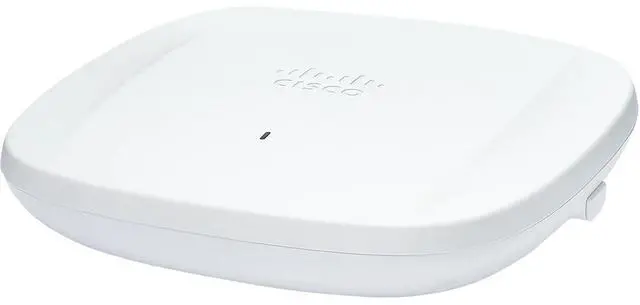
Cisco Catalyst 9176I (CW9176I)
★ 4.3 Value Score
Technical Specifications
- Wi-Fi Standard: Wi-Fi 7 (802.11be), with 4K-QAM and Multi-Link Operation (MLO)
- Spatial Streams (MIMO): 4x4:4 MU-MIMO on each of three radios (12 total per reseller listing)
- Aggregate Throughput: 18 Gbps aggregate (Cisco/Meraki and reseller figure; marketing rate, not a measured throughput)
- Radios (bands): Tri-radio: 2.4 GHz, 5 GHz, and 6 GHz (each 4x4), plus a dedicated scanning radio and IoT radio (BLE/UWB, GNSS on some SKUs)
- Uplink Port Speed: 1x 10 GbE multigigabit RJ-45 (1G/2.5G/5G/10G) per reseller listings; Cisco deployment guide references a 10G mGig PoE-in port. Sources are inconsistent, so verify against the official datasheet
- Max Clients: Not confirmed. No official per-AP client figure found in the sources reviewed; community guidance suggests roughly 50-75 active clients per 5 GHz radio
- PoE Requirement: 802.3bt (UPOE) for full performance; 802.3at (PoE+) runs in degraded mode (2x2 on 2.4 GHz, reduced features, USB disabled); 802.3af supports staging only. Maximum power draw about 39 W under 802.3bt (Meraki datasheet)
- Form Factor: Indoor access point with internal omnidirectional antennas
- Licensing: Requires a Cisco Networking Subscription for wireless (Essentials or Advantage)
- Pricing Note: Low/high range reflects reseller listings: sale prices about $1,543-$1,628, list price $3,245.83 (CDW, Avendor). Prices vary by reseller and date
Curation Review
- ✔ Pros: Wi-Fi 7 with 4K-QAM and Multi-Link Operation for high throughput and lower latency; tri-band 4x4 radios on 2.4, 5, and 6 GHz for dense environments; dedicated scanning and IoT radios (BLE/UWB) for location, IoT, and security monitoring without sacrificing client capacity; 10 GbE multigigabit uplink supports high-speed backhaul; flexible management through Cisco IOS-XE controllers, Meraki cloud, or Catalyst Center; full performance on standard 802.3bt PoE without a separate power supply
- ✘ Cons: Full performance requires 802.3bt (UPOE), and 802.3at PoE+ degrades radios and disables USB; the headline 18 Gbps figure is an aggregate marketing rate, not real-world throughput; no official per-AP client limit was found, which complicates capacity planning; requires a Cisco Networking Subscription license for wireless, adding recurring cost; premium pricing compared with many Wi-Fi 7 alternatives, with large price variation across resellers; indoor-only form factor; conflicting uplink details across sources should be confirmed against the official datasheet
- Est. Price: $1,543 - $3,246
Compare Against

Fortinet FortiAP-241K
★ 0.0 Value Score
Technical Specifications
- Wi-Fi Standard: Wi-Fi 7 (802.11be)
- Spatial Streams (MIMO): 2x2 MU-MIMO per serving radio (3 serving radios) plus a dedicated tri-band scanning radio
- Aggregate Throughput: ~10.8 Gbps (688 Mbps 2.4 GHz + 4.3 Gbps 5 GHz + 5.76 Gbps 6 GHz peak PHY rates)
- Radios (bands): 4 total: 2.4 GHz, 5 GHz, 6 GHz serving radios plus a tri-band (2.4/5/6 GHz) scanning radio
- Uplink Port Speed: 1x multigigabit RJ45 (100 Mbps to 10 Gbps) plus 1x 1 GbE
- Max Clients: 512 per serving radio
- PoE Requirement: 802.3bt for full four-radio operation; 802.3at for partial operation; 12 V / 3 A DC as alternative; max draw 26.1 W
Curation Review
- ✔ Pros: Tri-band Wi-Fi 7 with a dedicated scanning radio for continuous RF monitoring and security; 10 Gbps multigigabit uplink; Up to 512 clients per serving radio; Flexible power options (802.3bt, 802.3at partial, or 12 V DC); Managed through FortiGate, FortiManagement Cloud, or SASE-managed deployments
- ✘ Cons: Full four-radio operation requires 802.3bt PoE on LAN1; Peak aggregate of ~10.8 Gbps is well below some third-party claims (e.g., 13 Gbps); Some distributors list the model as end-of-life, so availability should be verified; 6 GHz use depends on regional regulatory approval; Price varies widely across regional SKUs (-A, -B, -E, -H, -N)
- Est. Price: $660 - $1,068