Primary Device
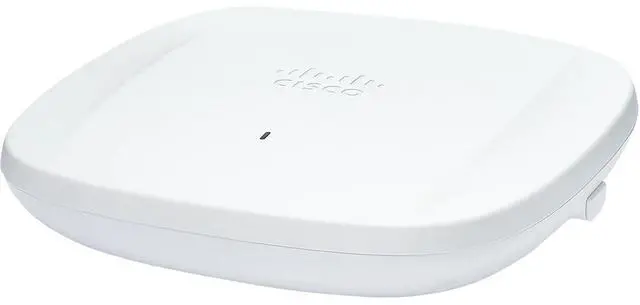
Cisco Catalyst 9176I (CW9176I)
★ 4.3 Value Score
Technical Specifications
- Wi-Fi Standard: 802.11be (Wi-Fi 7), backward compatible with 802.11a/b/g/n/ac/ax; Wi-Fi Alliance Wi-Fi 7 (R1) certified
- Spatial Streams (MIMO): 4x4:4SS on each of the three serving radios (12 total); 2.4 GHz drops to 2x2 under 802.3at
- Aggregate Throughput: Up to 18 Gbps PHY rate (802.11be, 4x4 at 320 MHz on 6 GHz, 160 MHz on 5 GHz, 20 MHz on 2.4 GHz); not a sustained throughput figure. Per-band PHY maximums per Meraki datasheet: 6 GHz 11,520 Mbps, 5 GHz 5,700 Mbps, 2.4 GHz 688 Mbps. Some listings cite 23 Gbps, which Cisco's datasheet appears to have as a typo
- Radios (bands): Three 4x4 serving radios (2.4 GHz, 5 GHz, 6 GHz); dedicated tri-band scanning radio (WIDS/WIPS, spectrum analysis); 2.4 GHz IoT radio; integrated BLE 5.3 (upgradable to BLE 6.0 in software); integrated GNSS/GPS and UWB
- Uplink Port Speed: 1x RJ-45 multigigabit (100M/1G/2.5G/5G/10G); 10G requires Cat6/Cat6A cabling; plus 1x USB 2.0 (9W) and 1x RJ-45 management console
- Max Clients: 1,200 total per Cisco scale (400 per radio); Cisco does not state a recommended practical client count
- PoE Requirement: 802.3bt Class 5 (UPOE), 39W max, required for 10G uplink, 4x4 on all bands and USB; 802.3at (25.5W) gives 2.5G uplink, 2x2 on 2.4 GHz and no USB; 802.3af (13.95W) for staging only with radios off. Cisco recommends CW-INJ-8 injector
- Antenna / Form Factor: Indoor, internal omnidirectional antennas (5 dBi 2.4 GHz, 6 dBi 5/6 GHz); directional variant is CW9176D1; 9.5 x 9.5 x 2.0 in (24 x 24 x 5.1 cm), 3.4 lb (1.56 kg)
- Management: Catalyst 9800 Series Wireless Controller (on-premises) or Meraki cloud management, depending on SKU; Meraki requires a license
- Price Source: Single reseller only (Aztek Computers, CW9176I-CFG, new, $3,547.97 current, $4,789.76 struck-through reference). No Cisco list price found. Cisco directs buyers to its price list or a partner quote
Curation Review
- ✔ Pros: Tri-band Wi-Fi 7 with 4x4 on all three client radios, giving high per-client throughput on 2.4, 5 and 6 GHz; Dedicated tri-band scanning radio supports 24/7 WIDS/WIPS and spectrum analysis without taking a client radio out of service; Integrated BLE 5.3, GNSS and UWB radios support asset tracking and location services in one AP; 10G mGig uplink removes the 1G bottleneck for Wi-Fi 7 traffic when 802.3bt PoE is available; Flexible management: Catalyst 9800 controller or Meraki cloud, with 1,200-client scale per Cisco; Wi-Fi 7 (R1), WPA3 and Suite B certifications
- ✘ Cons: 10G uplink and full 4x4 radio operation need 802.3bt (39W) PoE; 802.3at drops to 2.5G, reduces the 2.4 GHz radio to 2x2 and disables USB, which can force switch upgrades; Advertised 18 to 23 Gbps figures are PHY rates, not real-world throughput, and vendor sources disagree on the 23 Gbps value; Only one 10G uplink port and no second uplink for redundancy; Indoor omnidirectional model only; the directional variant is a separate SKU (CW9176D1); Meraki-managed SKUs require an ongoing license; Pricing data is limited to one reseller, and no official Cisco list price was found; Spec sources conflict on PoE (Cisco says 39W, a Meraki document says 60W Class 6), so verify before purchase
- Est. Price: $3,548 - $4,790
Compare Against
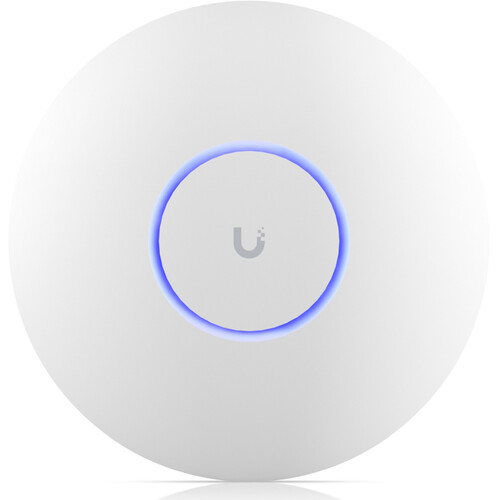
Ubiquiti UniFi U7 Pro Wall
★ 3.9 Value Score
Technical Specifications
- Wi-Fi Standard: Wi-Fi 7 (802.11be)
- Spatial Streams (MIMO): 6 total (2x2 per band on 2.4 GHz, 5 GHz and 6 GHz)
- Aggregate Throughput: 5.7 Gbps
- Radios (bands): Tri-band: 2.4 GHz (2x2), 5 GHz (2x2), 6 GHz (2x2)
- Uplink Port Speed: 1x 2.5 GbE
- Max Clients: 300+
- PoE Requirement: 802.3at PoE+ (44-57 V DC, about 22 W max)
Curation Review
- ✔ Pros: Tri-band Wi-Fi 7 with 2x2 on each band; 2.5 GbE uplink gives more wired headroom than 1 GbE models; Rated for 300+ clients; Runs on standard 802.3at PoE+, so no proprietary power supply is needed; Managed centrally through the UniFi controller; Wall-mount form factor suits offices and homes
- ✘ Cons: Single 2.5 GbE uplink caps wired throughput; Only 2x2 MU-MIMO per band, not 4x4; Rated coverage of about 140 m² (1,500 ft²) limits use in large open spaces; Reviewers report modest Wi-Fi 7 performance compared with premium APs; Full management requires a UniFi controller or UniFi OS
- Est. Price: $218 - $408