Primary Device
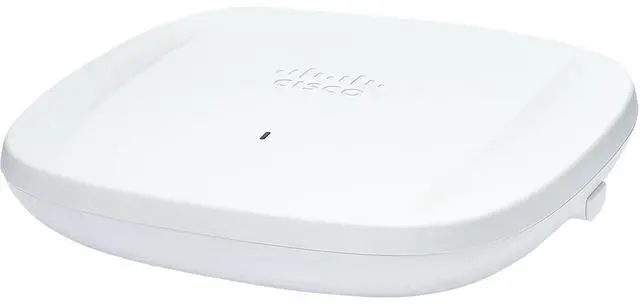
Cisco Cisco Wireless 9178I (CW9178I)
★ 3.6 Value Score
Technical Specifications
- Wi-Fi Standard: Wi-Fi 7 (802.11be)
- Spatial Streams (MIMO): 4x4:4 per radio (Up to 16 total streams)
- Aggregate Throughput: 24 Gbps
- Radios (bands): 2.4 GHz, 5 GHz, 6 GHz (Tri-radio or Quad-radio modes)
- Uplink Port Speed: 2 x 100M/1G/2.5G/5G/10G mGig (RJ-45)
- Max Clients: 1,200 total
- PoE Requirement: 802.3bt (UPOE) for full features; supports 802.3at/af with reduced performance
Curation Review
- ✔ Pros: Cutting-edge Wi-Fi 7 performance with up to 24 Gbps aggregate throughput; Flexible management options allowing a choice between Cisco Catalyst (on-prem) or Meraki (cloud); Exceptional high-density capacity supporting up to 1,200 clients and 16 spatial streams; Integrated dedicated scanning radio for security and BLE 5.3 for IoT applications
- ✘ Cons: Significant initial hardware cost and mandatory ongoing subscription licensing (DNA or Meraki); High power demands requiring 802.3bt (UPOE) infrastructure to unlock all capabilities; Bulkier and heavier than typical enterprise access points, requiring sturdy mounting
- Est. Price: $1,640 - $3,200
Compare Against
Cisco Catalyst 9176I (CW9176I)
★ 4.3 Value Score
Technical Specifications
- Switching Capacity: 51.2 Tbps
- Forwarding Rate: 38.4 Tbps
- Chassis Slots: 16-slot modular
- Port Options: Varies by line card configuration (up to 576 10GE/25GE ports or mixed)
- Layer Support: L2/L3
- PoE Support: Supported via optional PoE line cards
- Stacking Support: Yes, via Catalyst 9000 stacking
- Redundancy: Dual supervisor engines, hot-swappable
- Management: Cisco DNA Center compatible
- Max Power Consumption: 8400W
Curation Review
- ✔ Pros: Modular architecture allows flexible configuration for enterprise campuses; Extremely high switching capacity (51.2 Tbps) supports massive scale deployments; Full redundancy with dual supervisors and hot-swappable components; Integrated security and SD-Access ready; Supports latest 25GE/40GE/100GE line cards for future-proof design
- ✘ Cons: Very high capital expense ($85K–$125K+) makes it suitable only for large enterprises; Steep learning curve for network administrators unfamiliar with modular platforms; Requires significant power infrastructure (8400W maximum); Configuration complexity increases operational overhead; Price-to-performance ratio may be excessive for mid-market networks
- Est. Price: $85,000 - $125,000
Popular Comparisons
Cisco Cisco Wireless 9178I (CW9178I) vs Ubiquiti U7 Pro Max
Cisco Cisco Wireless 9178I (CW9178I) vs Ubiquiti U7 Pro
Cisco Cisco Wireless 9178I (CW9178I) vs Ubiquiti UniFi U7 Pro
Cisco Cisco Wireless 9178I (CW9178I) vs Cisco Catalyst 9178i
Cisco Cisco Wireless 9178I (CW9178I) vs Cisco Catalyst 9176I (CW9176I)