Primary Device
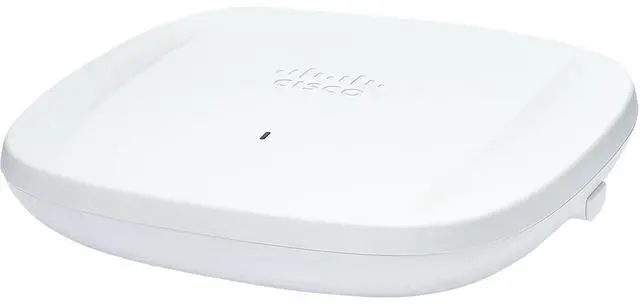
Cisco Cisco Wireless 9178I (CW9178I)
★ 3.6 Value Score
Technical Specifications
- Wi-Fi Standard: Wi-Fi 7 (802.11be)
- Spatial Streams (MIMO): 4x4:4 per radio (Up to 16 total streams)
- Aggregate Throughput: 24 Gbps
- Radios (bands): 2.4 GHz, 5 GHz, 6 GHz (Tri-radio or Quad-radio modes)
- Uplink Port Speed: 2 x 100M/1G/2.5G/5G/10G mGig (RJ-45)
- Max Clients: 1,200 total
- PoE Requirement: 802.3bt (UPOE) for full features; supports 802.3at/af with reduced performance
Curation Review
- ✔ Pros: Cutting-edge Wi-Fi 7 performance with up to 24 Gbps aggregate throughput; Flexible management options allowing a choice between Cisco Catalyst (on-prem) or Meraki (cloud); Exceptional high-density capacity supporting up to 1,200 clients and 16 spatial streams; Integrated dedicated scanning radio for security and BLE 5.3 for IoT applications
- ✘ Cons: Significant initial hardware cost and mandatory ongoing subscription licensing (DNA or Meraki); High power demands requiring 802.3bt (UPOE) infrastructure to unlock all capabilities; Bulkier and heavier than typical enterprise access points, requiring sturdy mounting
- Est. Price: $1,640 - $3,200
Compare Against

Cisco Catalyst 9178i
★ 4.3 Value Score
Technical Specifications
- Switching Capacity: 204.8 Tbps (full chassis)
- Forwarding Rate: 204.8 Tbps
- Ports: Up to 288 u00d7 10/25/40/100 Gbps (via modular line cards)
- Layer: L2/L3
- Stacking Support: Yes (up to 9 units via Stacking Cables)
- Chassis Type: 3-slot modular chassis
- PoE Budget: Up to 5.6 kW per module (optional PoE+ modules)
- Max Power Consumption: 10.2 kW (full chassis)
- Backplane Bandwidth: 204.8 Tbps
- Throughput per Port: Up to 100 Gbps per port
- Cooling: Redundant, variable-speed fans
- Uplinks: Multiple 100 Gbps QSFP28 capable
Curation Review
- ✔ Pros: Industry-leading 204.8 Tbps switching fabric supports next-generation high-density deployments; Modular architecture allows flexible line-card configurations for different port densities and speeds; Full redundancy support (PSU, fan, uplinks) ensures carrier-grade reliability; Native support for Cisco DNA Center and SD-Access intent-based networking; Excellent in-service upgrade capabilities with no traffic disruption
- ✘ Cons: Significantly higher capital cost compared to fixed-configuration switches; Requires skilled technical staff for modular line-card installation and configuration; Power and cooling infrastructure overhead for large deployments; Complexity of managing modular chassis in smaller networks may be overkill; Limited flexibility in port mix compared to disaggregated options
- Est. Price: $85,000 - $125,000
Popular Comparisons
Cisco Cisco Wireless 9178I (CW9178I) vs Ubiquiti U7 Pro Max
Cisco Cisco Wireless 9178I (CW9178I) vs Ubiquiti U7 Pro
Cisco Cisco Wireless 9178I (CW9178I) vs Ubiquiti UniFi U7 Pro
Cisco Cisco Wireless 9178I (CW9178I) vs Cisco Catalyst 9178i
Cisco Cisco Wireless 9178I (CW9178I) vs Cisco Catalyst 9176I (CW9176I)