Primary Device
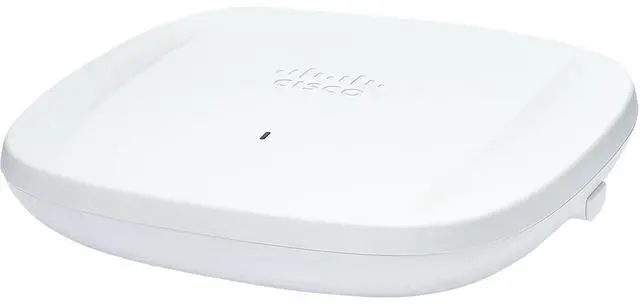
Cisco Cisco Wireless 9178I (CW9178I)
★ 3.6 Value Score
Technical Specifications
- Wi-Fi Standard: Wi-Fi 7 (802.11be)
- Spatial Streams (MIMO): 4x4:4 per radio (Up to 16 total streams)
- Aggregate Throughput: 24 Gbps
- Radios (bands): 2.4 GHz, 5 GHz, 6 GHz (Tri-radio or Quad-radio modes)
- Uplink Port Speed: 2 x 100M/1G/2.5G/5G/10G mGig (RJ-45)
- Max Clients: 1,200 total
- PoE Requirement: 802.3bt (UPOE) for full features; supports 802.3at/af with reduced performance
Curation Review
- ✔ Pros: Cutting-edge Wi-Fi 7 performance with up to 24 Gbps aggregate throughput; Flexible management options allowing a choice between Cisco Catalyst (on-prem) or Meraki (cloud); Exceptional high-density capacity supporting up to 1,200 clients and 16 spatial streams; Integrated dedicated scanning radio for security and BLE 5.3 for IoT applications
- ✘ Cons: Significant initial hardware cost and mandatory ongoing subscription licensing (DNA or Meraki); High power demands requiring 802.3bt (UPOE) infrastructure to unlock all capabilities; Bulkier and heavier than typical enterprise access points, requiring sturdy mounting
- Est. Price: $1,640 - $3,200
Compare Against

Ubiquiti U7 Pro
★ 4.7 Value Score
Technical Specifications
- Wi-Fi Standard: WiFi 7 (802.11be)
- Spatial Streams (MIMO): 4x4 (dual-band) / OFDMA
- Aggregate Throughput: 20.8 Gbps (combined across bands)
- Radios: Tri-band (2.4 GHz, 5 GHz, 6 GHz)
- 2.4 GHz Throughput: 4.8 Gbps
- 5 GHz Throughput: 8 Gbps
- 6 GHz Throughput: 8 Gbps
- Uplink Port Speed: 2.5 Gbps (RJ45)
- Max Clients: 200+
- PoE Requirement: PoE++ (802.3bt)
- Power Consumption: 18W typical
- Coverage: Up to 150+ meters (indoor)
- Dimensions: 185 x 185 x 38 mm
- Antenna Type: Internal multi-directional
Curation Review
- ✔ Pros: Next-generation WiFi 7 performance enabling multi-gigabit speeds; Tri-band design with dedicated 6GHz band reduces congestion and latency; Excellent client density support (200+ clients) with OFDMA and MU-MIMO; 2.5G uplink provides sufficient backhaul for AP-to-controller communication; PoE++ powered simplifies installation and eliminates separate power supplies; UniFi ecosystem integration with Network application for centralized management; Strong coverage range suitable for enterprise and large residential deployments; Low power consumption (18W) reduces operational costs
- ✘ Cons: Higher initial cost compared to WiFi 6E APs (price premium for WiFi 7 adoption); WiFi 7 client device adoption still limited (September 2026), reducing immediate ROI on upgrade; Requires PoE++ infrastructure which may not be available on existing switches; Tri-band operation increases interference management complexity; Large form factor (185x185mm) may require additional mounting considerations; UniFi management dependency—cannot operate standalone without controller; Limited compatibility with older legacy wireless devices on 6GHz band
- Est. Price: $399 - $599
Popular Comparisons
Cisco Cisco Wireless 9178I (CW9178I) vs Ubiquiti U7 Pro Max
Cisco Cisco Wireless 9178I (CW9178I) vs Ubiquiti U7 Pro
Cisco Cisco Wireless 9178I (CW9178I) vs Ubiquiti UniFi U7 Pro
Cisco Cisco Wireless 9178I (CW9178I) vs Cisco Catalyst 9178i
Cisco Cisco Wireless 9178I (CW9178I) vs Cisco Catalyst 9176I (CW9176I)