Primary Device
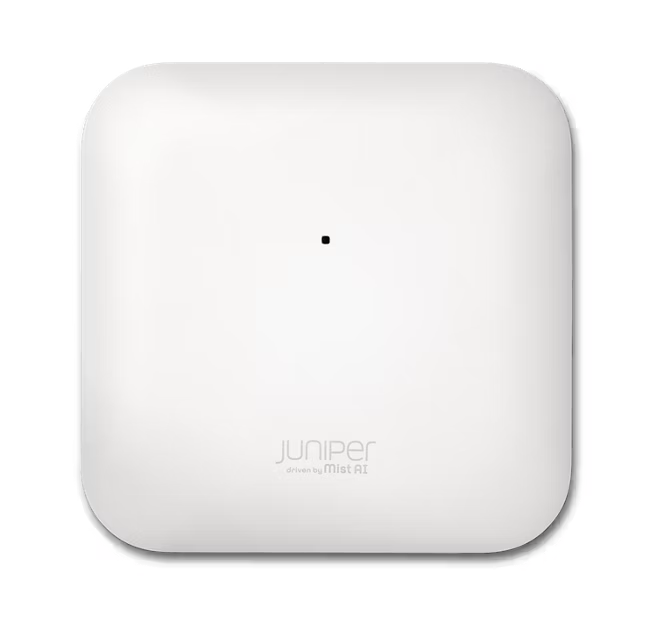
Juniper Networks AP66
★ 0.0 Value Score
Technical Specifications
- Wi-Fi Standard: Wi-Fi 7 (802.11be); backward compatible with 802.11a/b/g/n/ac/ax
- Spatial Streams (MIMO): 2x2:2 per radio on 2.4, 5 and 6 GHz; SU-MIMO and MU-MIMO
- Aggregate Throughput: 9.38 Gbps (reseller figure, roughly the sum of per-band rates of 0.688 + 2.9 + 5.8 Gbps; not an official Juniper aggregate)
- Radios (bands): 4 radios: 2.4 GHz, 5 GHz and 6 GHz data radios, plus a dedicated scanning radio; also an IoT radio, Bluetooth omnidirectional antenna and vBLE antenna array
- Uplink Port Speed: 1 x RJ-45, 1 GbE per reseller listing (not confirmed on the Juniper datasheet)
- Max Clients: Not published in sources reviewed
- PoE Requirement: 802.3at (PoE+); 25.5 W required for full functionality
- Antenna: Internal (AP66); internal directional 90x90/90x30/30x30 degrees (AP66D); external connectors (AP66E)
- Deployment / Operating Temp: Indoor/outdoor; -40 to 55 C; up to 3,048 m altitude
Curation Review
- ✔ Pros: Wi-Fi 7 (802.11be) with 802.11ax backward compatibility; Four radios, including a dedicated scanning radio, for continuous RF monitoring and security; Built-in IoT, BLE and vBLE support; Rated for indoor and outdoor deployment across -40 to 55 C; Runs on a single 802.3at PoE+ cable, so no separate power injector is needed; Managed through Juniper Mist cloud
- ✘ Cons: Single 1 GbE uplink (per reseller listing) may bottleneck the 2x2 radios in high-density use; Full functionality needs 25.5 W, which exceeds 802.3af PoE budgets; Max client count is not published; Mist cloud management typically requires paid subscription licensing; Only 2x2 streams per radio, below 4x4 enterprise Wi-Fi 7 APs; Premium price compared with Wi-Fi 6E and Wi-Fi 6 Juniper models
- Est. Price: $1,500 - $1,800
Compare Against
Choose another ap to compare.