Primary Device
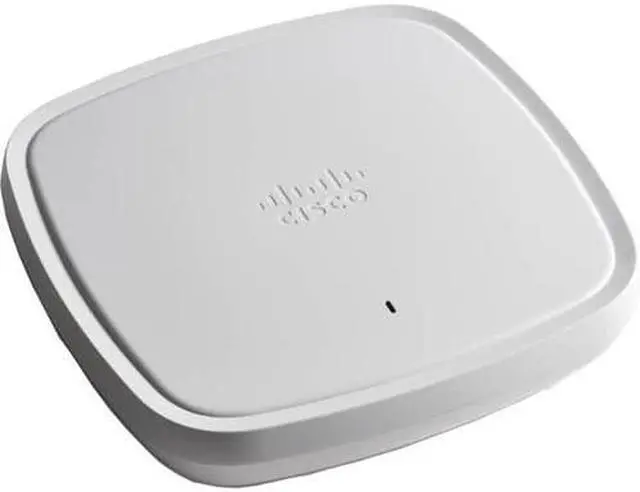
Cisco Catalyst 9120AX
★ 3.2 Value Score
Technical Specifications
- Wi-Fi Standard: 802.11ax (Wi-Fi 6)
- Spatial Streams (MIMO): 4x4:4 MU-MIMO on both radios with 802.3at/bt PoE; reduced to 1x1 on both radios, or 2x2 on one, under 802.3af
- Aggregate Throughput: Up to 5.38 Gbps PHY rate (5 GHz at 160 MHz, 2.4 GHz at 20 MHz); dual 5 GHz mode up to 5.2 Gbps (2 x 2.6 Gbps)
- Radios (bands): 2 main radios: 1 flexible 2.4 GHz or 5 GHz radio, plus 1 dedicated 5 GHz radio. Dual 5 GHz mode is supported. Some variants add a BLE/802.15.4 radio.
- Uplink Port Speed: 1 x multigigabit RJ-45 port (100/1000/2500 Mbps, IEEE 802.3bz); 2.5 Gbps requires Cat 5e or better. 1 Gbps uplink under 802.3af.
- Max Clients: Not published in Cisco datasheet
- PoE Requirement: 802.3at (PoE+) or 802.3bt (UPOE/UPOE+) for full capability, 25.5 W max draw; 802.3af supported at 13.4 W max draw with reduced radio and uplink capability
Curation Review
- ✔ Pros: Full 4x4:4 on both radios with 802.3at/bt PoE; Wi-Fi 6 (802.11ax) with OFDMA and MU-MIMO for dense client environments; Multigigabit 2.5 Gbps uplink avoids the 1 Gbps bottleneck; Model choice for internal (AXI), external antenna (AXE), or professional external antenna (AXP) deployments; Optional embedded wireless controller (-EWC) variants for small deployments; Dual 5 GHz mode for higher 5 GHz capacity; Supports Cisco power injectors for 802.3af or 802.3at environments
- ✘ Cons: Full performance needs 802.3at/bt PoE; 802.3af drops radios to 1x1 or 2x2 and the uplink to 1 Gbps; No 5 Gbps or 10 Gbps uplink on the base model; Max client count not published by Cisco; Higher price than many Wi-Fi 6 APs from competing vendors; Some older listings show Wi-Fi 6E or older variants, so confirm the exact part number before purchase; Prices vary widely across resellers and regions and may not reflect current Cisco list pricing
- Est. Price: $1,550 - $2,863
Compare Against

Cisco Catalyst 9166 Series (CW9166)
★ 4.2 Value Score
Technical Specifications
- Wi-Fi Standard: 802.11ax (Wi-Fi 6E, 6 GHz capable); also 802.11a/b/g/n/ac backward compatible
- Spatial Streams (MIMO): 4x4:4 on each of the three client radios (2.4 GHz, 5 GHz, 6 GHz); MU-MIMO and OFDMA supported
- Aggregate Throughput: Up to 7.78 Gbps tri-radio aggregate (maximum over-the-air PHY/chipset frame rate, not per-client throughput)
- Radios (bands): Tri-radio 4x4:4: 2.4 GHz client radio, 5 GHz client radio, 6 GHz client radio; plus tri-band scanning radio (2.4/5/6 GHz) for security/RF analytics and a 2.4 GHz Bluetooth Low Energy radio
- Uplink Port Speed: 1x multigigabit RJ45 (100 Mbps / 1 Gbps / 2.5 Gbps / 5 Gbps BASE-T); also 1 USB 2.0 Type-A port
- Max Clients: Not published in the sources reviewed
- PoE Requirement: 802.3bt (UPOE) 30.5 W for full functionality including USB; 802.3at (PoE+) 25 W supported with reduced functionality and no USB; 802.3af not supported; 54 V DC option available
- Form Factor: Indoor ceiling/wall-mount access point; omnidirectional (CW9166I) or directional (CW9166D1) antenna variants
- Dimensions: 241.3 x 241.3 x 56.9 mm (CW9166I) / 57.9 mm height (CW9166D1); approx. 1.6 kg
- Management: Catalyst 9800 wireless controllers (IOS-XE) or Meraki cloud (CW9166I-MR / CW9166D1-MR SKUs)
Curation Review
- ✔ Pros: Tri-band Wi-Fi 6E with 4x4:4 on every client radio for high-density capacity; dedicated tri-band scanning radio for WIPS, spectrum analysis, and location analytics; multigigabit 5 Gbps uplink on a single RJ45 port; Bluetooth Low Energy radio for beacons and asset tracking; supports both Catalyst 9800 controller and Meraki cloud management; full functionality on 802.3bt PoE with USB output
- ✘ Cons: Full feature set requires 802.3bt (UPOE) power, and 802.3at operation reduces functionality; only one uplink port, so no link aggregation or redundancy; premium price compared with many Wi-Fi 6E APs; maximum client count is not published in available sources; Catalyst (CW9166I-B/-E) and Meraki (CW9166I-MR) SKUs are the same hardware under different management licences, which can confuse purchasing; end-of-sale/end-of-life status is unconfirmed and should be checked with Cisco
- Est. Price: $1,136 - $3,317