Primary Device
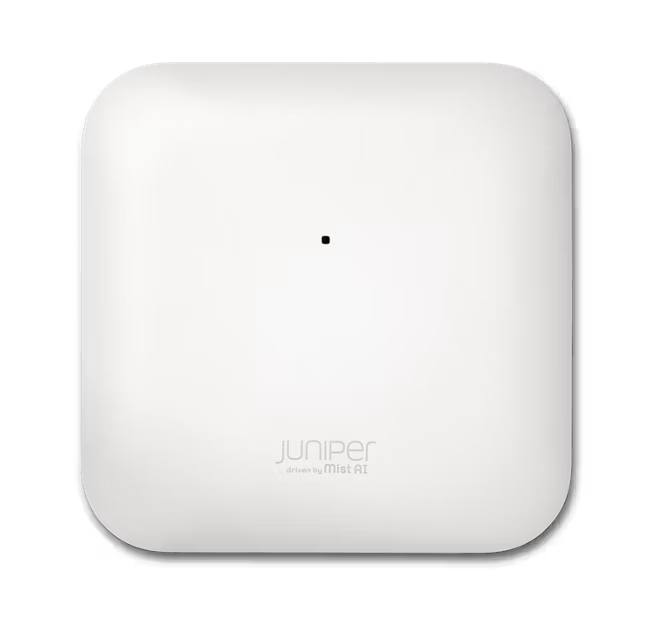
Juniper Networks Mist AP43
★ 3.3 Value Score
Technical Specifications
- Wi-Fi Standard: 802.11ax (Wi-Fi 6)
- Spatial Streams (MIMO): 4x4 MIMO (5GHz), 2x2 MIMO (2.4GHz)
- Aggregate Throughput: 1.2 Gbps (1200 Mbps)
- Radios (bands): Dual-band (2.4GHz + 5GHz)
- Uplink Port Speed: 1 GbE PoE+
- Max Clients: 256
- PoE Requirement: 802.3at PoE+ (30W)
Curation Review
- ✔ Pros: Enterprise-class Wi-Fi 6 performance with industry-leading range and coverage ratio (typically 1:15-1:20); Cloud-managed via Mist platform with built-in AI/ML-driven optimization for automatic channel/power adjustment and rogue AP detection; Excellent throughput efficiency with OFDMA and spatial multiplexing reducing latency in dense deployments; Robust security features including built-in 802.1X, WPA3 support, and encrypted management; Reliable power delivery with standard PoE+ enabling flexible deployment without additional power infrastructure
- ✘ Cons: Requires active Mist subscription for cloud management and advanced features, limiting use cases for cost-conscious small deployments; Uplink limited to 1 GbE PoE+ may bottleneck in high-density environments requiring multi-gigabit aggregation; Higher total cost of ownership compared to entry-level or consumer-grade access points; Cloud dependency introduces potential latency and management complexity if internet connectivity is interrupted; PoE power budget (30W) may be insufficient for future higher-power Wi-Fi 6E or Wi-Fi 7 features or add-on modules
- Est. Price: $500 - $750
Compare Against
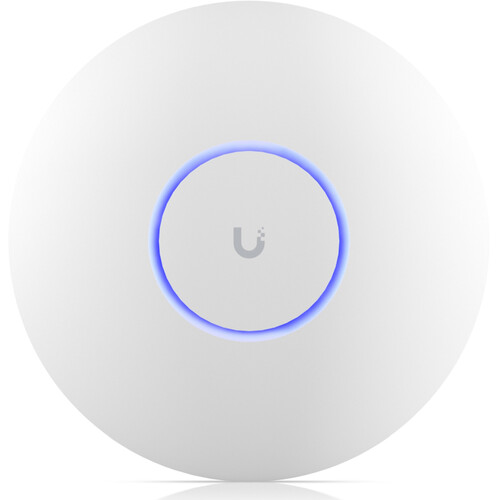
Ubiquiti UniFi U7 Pro
★ 4.6 Value Score
Technical Specifications
- Wi-Fi Standard: Wi-Fi 7 (802.11be)
- Aggregate Throughput: BE19000 (approximately 19 Gbps)
- 2.4 GHz Spatial Streams: 2x2 MIMO
- 5 GHz Spatial Streams: 4x4 MIMO
- 6 GHz Spatial Streams: 4x4 MIMO
- Radios: Tri-band (2.4 GHz, 5 GHz, 6 GHz)
- Uplink Port Speed: 10 GbE
- Max Clients: 300+
- PoE Requirement: PoE++ (95W)
Curation Review
- ✔ Pros: Wi-Fi 7 future-proofing with extremely high throughput; 10GbE uplink for backhaul capacity; Enterprise-grade build quality and management integration; Excellent performance in dense deployments; PoE powered for simplified installation
- ✘ Cons: Premium pricing significantly higher than Wi-Fi 6E alternatives; Requires PoE++ power injection (standard PoE insufficient); Wi-Fi 7 client ecosystem still maturing with limited device adoption; Overkill for small/residential deployments; Generates notable heat requiring adequate ventilation
- Est. Price: $449 - $549