Primary Device
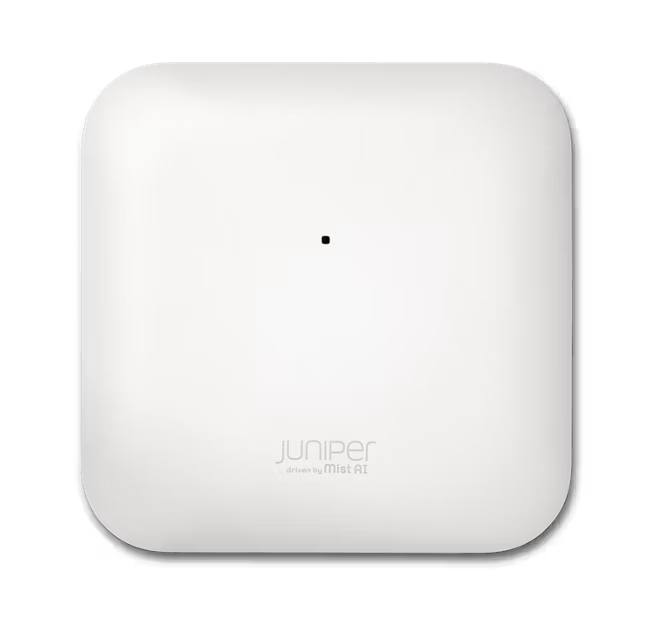
Juniper Networks Mist AP43
★ 3.3 Value Score
Technical Specifications
- Wi-Fi Standard: 802.11ax (Wi-Fi 6)
- Spatial Streams (MIMO): 4x4 MIMO (5GHz), 2x2 MIMO (2.4GHz)
- Aggregate Throughput: 1.2 Gbps (1200 Mbps)
- Radios (bands): Dual-band (2.4GHz + 5GHz)
- Uplink Port Speed: 1 GbE PoE+
- Max Clients: 256
- PoE Requirement: 802.3at PoE+ (30W)
Curation Review
- ✔ Pros: Enterprise-class Wi-Fi 6 performance with industry-leading range and coverage ratio (typically 1:15-1:20); Cloud-managed via Mist platform with built-in AI/ML-driven optimization for automatic channel/power adjustment and rogue AP detection; Excellent throughput efficiency with OFDMA and spatial multiplexing reducing latency in dense deployments; Robust security features including built-in 802.1X, WPA3 support, and encrypted management; Reliable power delivery with standard PoE+ enabling flexible deployment without additional power infrastructure
- ✘ Cons: Requires active Mist subscription for cloud management and advanced features, limiting use cases for cost-conscious small deployments; Uplink limited to 1 GbE PoE+ may bottleneck in high-density environments requiring multi-gigabit aggregation; Higher total cost of ownership compared to entry-level or consumer-grade access points; Cloud dependency introduces potential latency and management complexity if internet connectivity is interrupted; PoE power budget (30W) may be insufficient for future higher-power Wi-Fi 6E or Wi-Fi 7 features or add-on modules
- Est. Price: $500 - $750
Compare Against
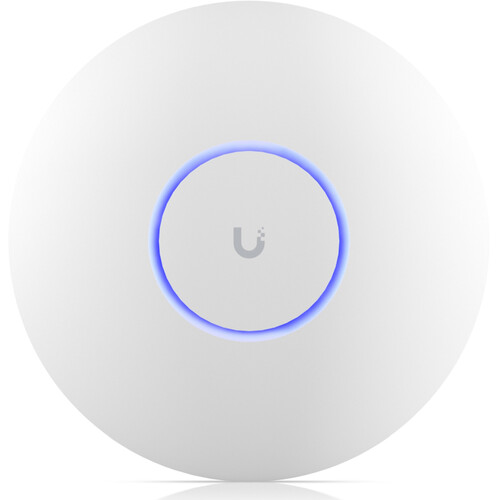
Ubiquiti U7 Pro
★ 4.7 Value Score
Technical Specifications
- Wi-Fi Standard: WiFi 7 (802.11be)
- Spatial Streams (MIMO): 4x4 (dual-band) / OFDMA
- Aggregate Throughput: 20.8 Gbps (combined across bands)
- Radios: Tri-band (2.4 GHz, 5 GHz, 6 GHz)
- 2.4 GHz Throughput: 4.8 Gbps
- 5 GHz Throughput: 8 Gbps
- 6 GHz Throughput: 8 Gbps
- Uplink Port Speed: 2.5 Gbps (RJ45)
- Max Clients: 200+
- PoE Requirement: PoE++ (802.3bt)
- Power Consumption: 18W typical
- Coverage: Up to 150+ meters (indoor)
- Dimensions: 185 x 185 x 38 mm
- Antenna Type: Internal multi-directional
Curation Review
- ✔ Pros: Next-generation WiFi 7 performance enabling multi-gigabit speeds; Tri-band design with dedicated 6GHz band reduces congestion and latency; Excellent client density support (200+ clients) with OFDMA and MU-MIMO; 2.5G uplink provides sufficient backhaul for AP-to-controller communication; PoE++ powered simplifies installation and eliminates separate power supplies; UniFi ecosystem integration with Network application for centralized management; Strong coverage range suitable for enterprise and large residential deployments; Low power consumption (18W) reduces operational costs
- ✘ Cons: Higher initial cost compared to WiFi 6E APs (price premium for WiFi 7 adoption); WiFi 7 client device adoption still limited (September 2026), reducing immediate ROI on upgrade; Requires PoE++ infrastructure which may not be available on existing switches; Tri-band operation increases interference management complexity; Large form factor (185x185mm) may require additional mounting considerations; UniFi management dependency—cannot operate standalone without controller; Limited compatibility with older legacy wireless devices on 6GHz band
- Est. Price: $399 - $599