Max Clients: 250+ (official Ubiquiti tech specs; some retailers list 300+)
PoE Requirement: PoE powered, 44-57V DC input, 13W max consumption; 802.3af/at not specified by Ubiquiti; no PoE injector in the spec listing
Curation Review
✔ Pros:Wi-Fi 6 with 4x4 MU-MIMO on 5 GHz for good multi-client performance; Aggregate throughput up to 5.3 Gbps across both bands; Low 13W power draw compared with higher-end APs; Works with UniFi Network controller for centralized management; Ceiling or wall mounting with included Pro Mount; Compact, low-profile design (about 197 mm diameter, 35 mm height)
✘ Cons:Only a single 1 GbE uplink, which can bottleneck the 5 GHz radio on fast networks; No 2.5 GbE or multi-gig port; PoE standard not clearly specified, so verify your switch or injector supplies enough power; PoE injector is not included with the US model, which adds cost; Client capacity is lower on the official spec (250+) than some retailer marketing claims (300+); Requires a UniFi controller for full feature use
Est. Price:
$159 - $185
Compare Against
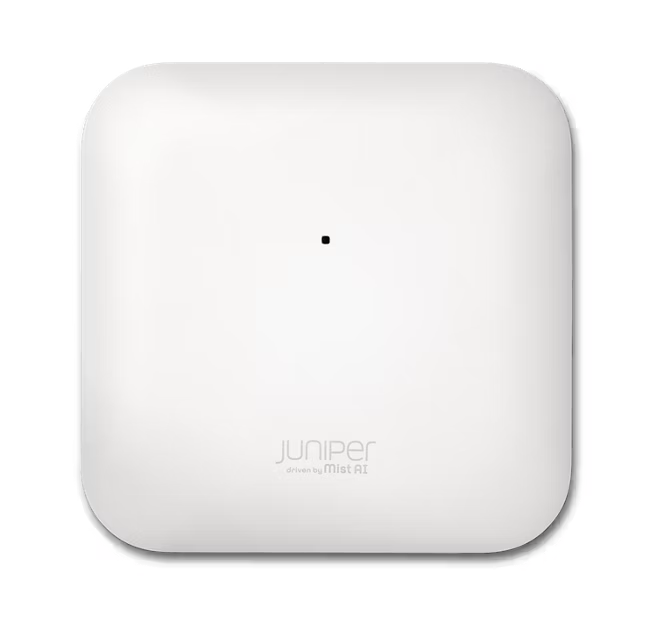
Juniper Networks AP37
★ 3.3 Value Score
Technical Specifications
Wi-Fi Standard: Wi-Fi 7 (IEEE 802.11be), backward compatible with 802.11a/b/g/n/ac/ax
Spatial Streams (MIMO): 2.4 GHz: 2x2:2; 5 GHz: 4x4:4; 6 GHz: 4x4:4 (10 total streams); SU-MIMO and MU-MIMO
Aggregate Throughput: 17.98 Gbps (sum of per-radio maximums: 0.688 + 5.76 + 11.53 Gbps); not an officially published aggregate figure
Radios (bands): 4 radios: 2.4 GHz (2x2:2), 5 GHz (4x4:4), 6 GHz (4x4:4), plus a dedicated scanning radio; IoT radio also included
Uplink Port Speed: 2x RJ-45 Ethernet ports, both PoE-capable; port speed not published by Juniper
Max Clients: Not published by Juniper
PoE Requirement: 802.3bt for full functionality (29.3 W); 802.3at supported with reduced functionality
Bluetooth / Location: Bluetooth LE with virtual BLE (vBLE) support; GPS/GNSS listed as supported
Other Ports: 1x USB port
Dimensions / Weight: 23 cm H x 23 cm W x 8.2 cm D; 1.55 kg
Operating Environment: 0 to 40 C, 10% to 90% humidity, rated to 3,048 m altitude
Management: Juniper Mist cloud management with AI-driven operations (AIOps)
Curation Review
✔ Pros:Tri-band Wi-Fi 7 (802.11be) with 4x4:4 on both 5 GHz and 6 GHz for high-capacity client service; Dedicated scanning radio supports continuous RF monitoring and security/AIOps; Virtual BLE array and GNSS support for location-based services; Managed through the Juniper Mist cloud with AI-driven operations; Two PoE-capable Ethernet ports and an integrated IoT radio and USB port add flexibility
✘ Cons:Full functionality requires 802.3bt (29.3 W); 802.3at power forces reduced functionality; Maximum client count and Ethernet port speed are not published, so multi-gig uplink cannot be confirmed; Internal antennas only and rated for indoor deployment only; Advertised pricing bundles a Mist subscription term, so hardware-only cost is not clearly separated; 2.4 GHz radio is limited to 2x2:2