Primary Device
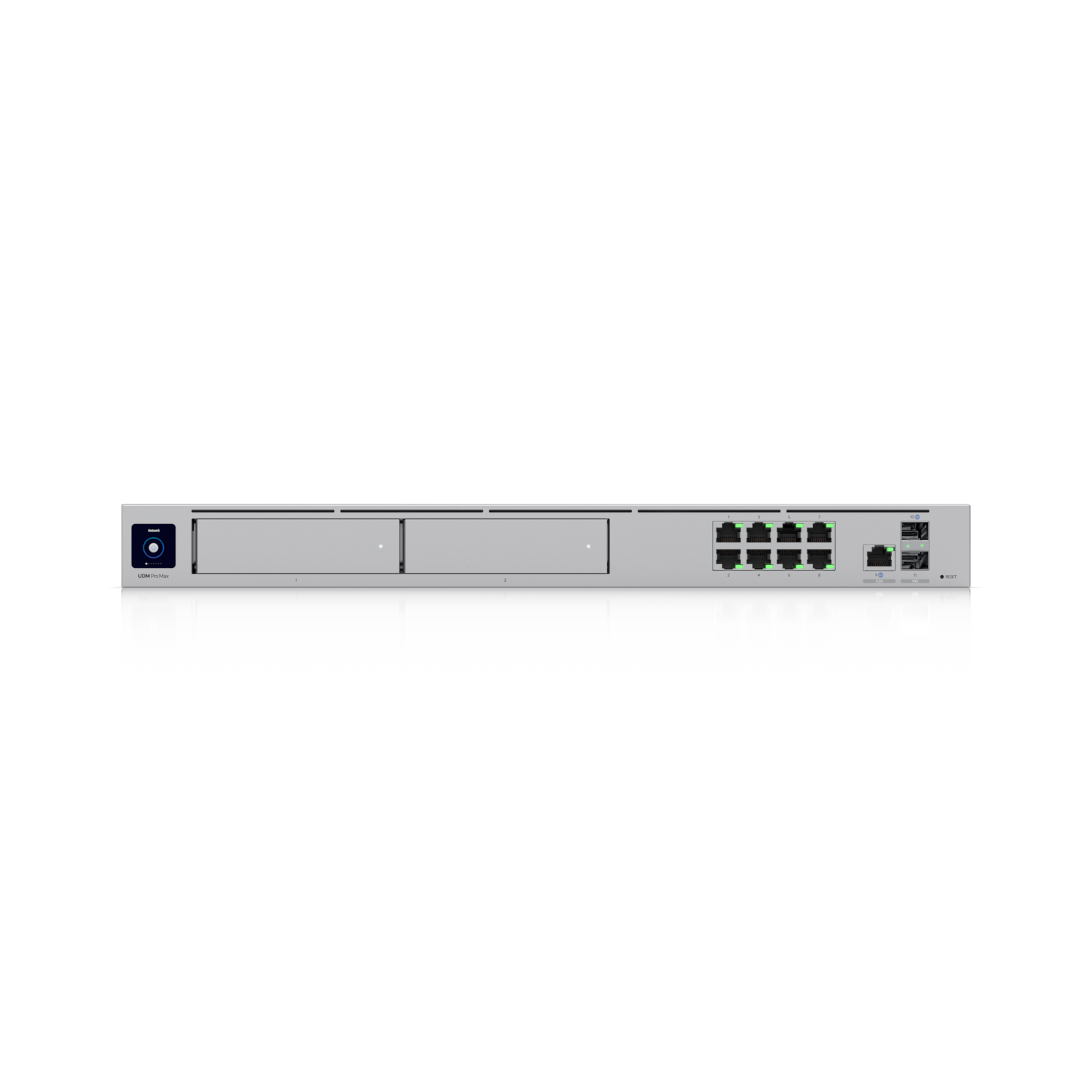
Ubiquiti UniFi Dream Machine Pro Max
★ 5.0 Value Score
Technical Specifications
- Firewall Throughput: Not published by Ubiquiti
- Threat Prevention Throughput: 5 Gbps IDS/IPS (Ubiquiti spec); 55,000+ IDS/IPS signatures with CyberSecure
- IPsec VPN Throughput: Not published by Ubiquiti
- Max Sessions: Not published by Ubiquiti
- New Sessions/sec: Not published by Ubiquiti
- Interfaces: 8x 1GbE RJ45 (1G/100M/10M); 1x 2.5GbE RJ45 (2.5G/1G/100M/10M); 2x 10G SFP+ (10G/1G); default WAN is 1x 10G SFP+ and 1x 2.5GbE RJ45; up to 8 WAN ports supported
- Form Factor: Rack mount 1U (442.4 x 43.7 x 285.6 mm; 4.7 kg)
- Processor: Quad-core ARM Cortex-A57 @ 2.0 GHz
- System Memory: 8 GB
- Onboard Storage: 32 GB eMMC; 128 GB integrated SSD; 2x 3.5in NVR HDD bays
- Max Power Consumption: 60W (100W internal AC/DC PSU)
- Managed UniFi Devices: 200+
- Simultaneous Users: 2,000+
- MAC Address Table Size: 4,000
- Redundancy: Shadow Mode (VRRP), Gateway Failover, DC power backup (USP-RPS)
- PoE Budget: None (not a PoE device)
- Layer: L3 gateway (routing, OSPF, BGP, zone-based firewall)
Curation Review
- ✔ Pros: Ubiquiti rates 5 Gbps IDS/IPS throughput, which is strong for a 1U gateway at this price; Ten gigabit SFP+ ports plus a 2.5GbE port give fast multi-WAN and uplink options; Integrated 128 GB SSD and two NVR HDD bays allow local UniFi Protect recording without extra hardware; Full feature set including zone-based firewall, DPI, content filtering, IPsec/OpenVPN/WireGuard VPN, OSPF and BGP; Redundancy options such as VRRP shadow mode, gateway failover and DC power backup; Low 60W maximum power draw and NDAA-compliant hardware
- ✘ Cons: Ubiquiti does not publish firewall throughput, VPN throughput, session capacity or new sessions per second, which makes sizing harder; Only 5 Gbps IDS/IPS is specified, which may bottleneck high-bandwidth sites with threat prevention enabled; Eight 1GbE LAN ports is limited if you need many wired drops or 2.5G/10G client access; No PoE, so separate switches or injectors are needed for PoE devices; Retail prices vary widely across sellers, and the price range is wider than the official MSRP suggests; Requires UniFi Network controller management, which may not suit teams wanting a standalone firewall
- Est. Price: $599 - $740
Compare Against

HPE Aruba Networking 9004 (RW, R1B21A)
★ 0.0 Value Score
Technical Specifications
- Firewall Throughput: 4 Gbps (SD-WAN mode, small site); 6 Gbps is the 9012 figure, not the 9004
- Threat Prevention Throughput: Not published. IDS/IPS is a licensed feature (requires Aruba Central subscription) with no throughput figure in the datasheet
- IPsec VPN Throughput: Not published directly. Mobility Controller mode: 4 Gbps encrypted 3DES and AES-CBC-256, 2 Gbps AES-CCM, 4 Gbps AES-GCM-256
- Max Sessions: 64K active firewall sessions
- New Sessions/sec: Not published
- Interfaces: 4x 100/1000BASE-T (GbE RJ45); 1x USB 3.0 Type-A; 1x console (micro USB or RJ45); Bluetooth 5 / BLE IoT radio; no SFP or 10G ports
- Form Factor: Desktop/fanless, 1RU rack-mountable with optional mount rack tray (two 9004s can sit side by side with a mount kit)
- Max Clients: Up to 2,048 users/devices
- Max Access Points: 32 campus or remote APs (Mobility Controller mode)
- Max VLANs: 4,096
- Concurrent IPsec Sessions: 2,048
- Software Requirement: Aruba Central (SD-WAN mode) or AOS 10.4+ / AOS 8.5+ with the appropriate licenses
- Model Variants: 9004 (R1B21A) is the non-LTE model; 9004-LTE adds an integrated LTE Cat 12 modem (600/150 Mbps)
Curation Review
- ✔ Pros: Compact fanless desktop form factor suited to small branch sites; Four GbE ports plus Bluetooth 5 IoT radio for wired and IoT connectivity; Supports SD-WAN mode through Aruba Central and Mobility Controller mode for WLAN/LAN services; Dynamic Segmentation and Layer 4-7 stateful firewall with policy enforcement across wired, wireless and WAN; Scales to 2,048 clients, 32 APs and 64K firewall sessions; Clusterable with N+1 or NxN redundancy when deployed as a Mobility Controller; Can be managed with cloud-based Aruba Central and mobile onboarding
- ✘ Cons: Only 4 GbE ports and no SFP or 10G uplinks, which limits uplink options; Firewall throughput of 4 Gbps is modest for larger sites and below the 9012's 6 Gbps; IDS/IPS threat defense requires a separate Aruba Central subscription license; Threat prevention and new-sessions-per-second figures are not published; Dual-mode licensing (SD-WAN vs. AOS Controller mode) adds ordering and deployment complexity; Conflicting third-party listings for weight, dimensions and power, so physical specs need checking against the official datasheet; Listed prices vary widely by region and seller, and US retail figures are approximate
- Est. Price: $1,293 - $1,831
Popular Comparisons
Ubiquiti UniFi Dream Machine Pro Max vs Ubiquiti UniFi Cloud Gateway Fiber
Ubiquiti UniFi Dream Machine Pro Max vs Ubiquiti Cloud Gateway Max
Ubiquiti UniFi Dream Machine Pro Max vs Ubiquiti UniFi Cloud Gateway Max (UCG-Max)
Ubiquiti UniFi Dream Machine Pro Max vs Ubiquiti Enterprise Fortress Gateway (EFG)
Ubiquiti UniFi Dream Machine Pro Max vs Fortinet FortiGate 400G