Primary Device
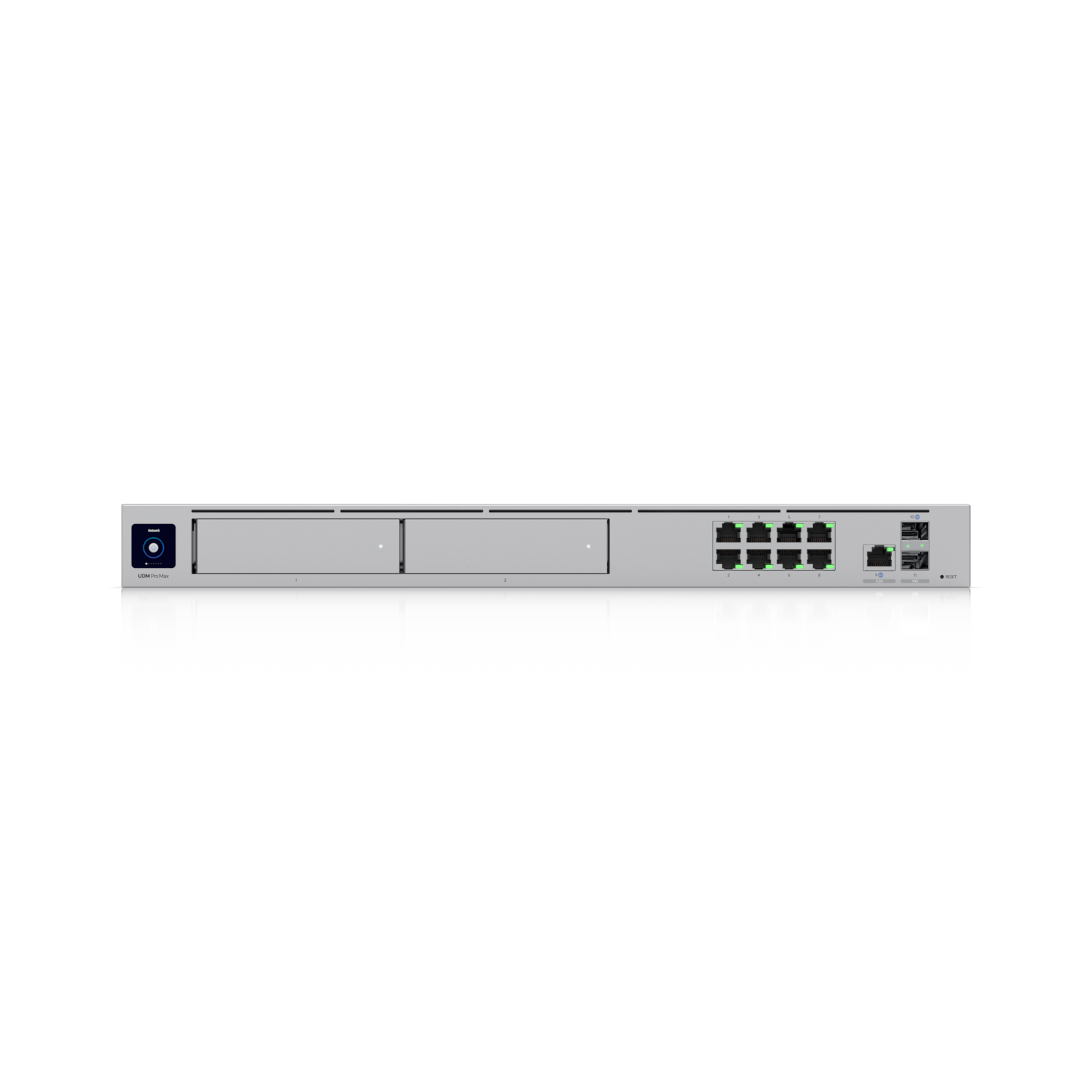
Ubiquiti UniFi Dream Machine Pro Max
★ 5.0 Value Score
Technical Specifications
- Firewall Throughput: Not published by Ubiquiti
- Threat Prevention Throughput: 5 Gbps IDS/IPS (Ubiquiti spec); 55,000+ IDS/IPS signatures with CyberSecure
- IPsec VPN Throughput: Not published by Ubiquiti
- Max Sessions: Not published by Ubiquiti
- New Sessions/sec: Not published by Ubiquiti
- Interfaces: 8x 1GbE RJ45 (1G/100M/10M); 1x 2.5GbE RJ45 (2.5G/1G/100M/10M); 2x 10G SFP+ (10G/1G); default WAN is 1x 10G SFP+ and 1x 2.5GbE RJ45; up to 8 WAN ports supported
- Form Factor: Rack mount 1U (442.4 x 43.7 x 285.6 mm; 4.7 kg)
- Processor: Quad-core ARM Cortex-A57 @ 2.0 GHz
- System Memory: 8 GB
- Onboard Storage: 32 GB eMMC; 128 GB integrated SSD; 2x 3.5in NVR HDD bays
- Max Power Consumption: 60W (100W internal AC/DC PSU)
- Managed UniFi Devices: 200+
- Simultaneous Users: 2,000+
- MAC Address Table Size: 4,000
- Redundancy: Shadow Mode (VRRP), Gateway Failover, DC power backup (USP-RPS)
- PoE Budget: None (not a PoE device)
- Layer: L3 gateway (routing, OSPF, BGP, zone-based firewall)
Curation Review
- ✔ Pros: Ubiquiti rates 5 Gbps IDS/IPS throughput, which is strong for a 1U gateway at this price; Ten gigabit SFP+ ports plus a 2.5GbE port give fast multi-WAN and uplink options; Integrated 128 GB SSD and two NVR HDD bays allow local UniFi Protect recording without extra hardware; Full feature set including zone-based firewall, DPI, content filtering, IPsec/OpenVPN/WireGuard VPN, OSPF and BGP; Redundancy options such as VRRP shadow mode, gateway failover and DC power backup; Low 60W maximum power draw and NDAA-compliant hardware
- ✘ Cons: Ubiquiti does not publish firewall throughput, VPN throughput, session capacity or new sessions per second, which makes sizing harder; Only 5 Gbps IDS/IPS is specified, which may bottleneck high-bandwidth sites with threat prevention enabled; Eight 1GbE LAN ports is limited if you need many wired drops or 2.5G/10G client access; No PoE, so separate switches or injectors are needed for PoE devices; Retail prices vary widely across sellers, and the price range is wider than the official MSRP suggests; Requires UniFi Network controller management, which may not suit teams wanting a standalone firewall
- Est. Price: $599 - $740
Compare Against

Palo Alto Networks PA-5500 Series
★ 0.0 Value Score
Technical Specifications
- Firewall Throughput: 150 Gbps (PA-5540) / 175 Gbps (PA-5550) / 375 Gbps (PA-5580), AppMix per reseller listings; not confirmed against Palo Alto's datasheet
- Threat Prevention Throughput: 90 Gbps (PA-5540) / 120 Gbps (PA-5550) / 300 Gbps (PA-5580); series range 90-300 Gbps per Palo Alto docs
- IPsec VPN Throughput: 80 Gbps (PA-5540) / 100 Gbps (PA-5550) / 240 Gbps (PA-5580), per reseller listings
- Max Sessions: 39M (PA-5540) / 49M (PA-5550) / 99M (PA-5580), per reseller listings; series up to 99M per Palo Alto docs
- New Sessions/sec: 1.33M (PA-5540) / 1.67M (PA-5550); up to 3M across series per Palo Alto docs
- Interfaces: PA-5540 (reseller listing): 16x 10/25G SFP28, 16x 40/100G QSFP28, 4x 100/400G QSFP-DD, 2x SFP+ management, 2x SFP+ logging, HSCI ports for clustering. Port counts for PA-5510 through PA-5580 not verified from the official per-model pages
- Form Factor: 2RU for PA-5510/5520/5530; 3RU for PA-5540/5550/5560/5570/5580 (Palo Alto hardware reference). Dimensions 17.3 in W; 3RU models 29.8 in D, 78-79 lb
- Power Supply: PA-5510/5520/5530: 1x 1200W AC or DC required, second optional for redundancy (1125W max). PA-5540 and higher: up to four 2700W load-sharing supplies (3100W max, about 2100W average)
- Layer: L3 next-generation firewall (no switching or PoE function)
- Source Notes: Palo Alto official docs confirm series range, form factors, and power. Per-model performance and port figures come from reseller listings and are not verified against the official PA-5500 datasheet PDF. Price range is a single PA-5540 reseller listing (Duman Stars: $16,385.78 current, $23,747.50 struck-through original). No official list price was found, and PA-5550 pricing was not found, so this range may not represent the series.
Curation Review
- ✔ Pros: Very high firewall and threat prevention throughput across the series, up to 375 Gbps and 300 Gbps (PA-5580); Session capacity scales to 99M concurrent sessions for large data center and carrier-scale deployments; Redundant, hot-swappable power supplies on all models; Rich high-speed connectivity including 100/400G QSFP-DD on PA-5540; Official docs confirm the series spans 2RU and 3RU models, so it can fit different rack and capacity needs
- ✘ Cons: No official list price found, and the one reseller price is for PA-5540 only, so budget planning is uncertain; Per-model performance and port figures come from resellers that conflict with each other and are not verified against Palo Alto's datasheet; Top-end models draw up to 3100W and need up to four power supplies, which increases power and cooling requirements; 3RU footprint for PA-5540 and higher uses more rack space than the 2RU PA-5510 to PA-5530; Full capability depends on license and subscription add-ons, which increase total cost of ownership
- Est. Price: $16,386 - $23,748
Popular Comparisons
Ubiquiti UniFi Dream Machine Pro Max vs Ubiquiti UniFi Cloud Gateway Fiber
Ubiquiti UniFi Dream Machine Pro Max vs Ubiquiti Cloud Gateway Max
Ubiquiti UniFi Dream Machine Pro Max vs Ubiquiti UniFi Cloud Gateway Max (UCG-Max)
Ubiquiti UniFi Dream Machine Pro Max vs Ubiquiti Enterprise Fortress Gateway (EFG)
Ubiquiti UniFi Dream Machine Pro Max vs Fortinet FortiGate 400G