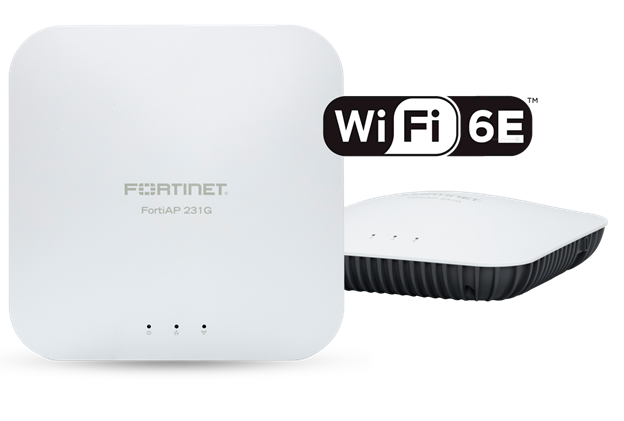
Radios (bands): 3 radios: 2.4 GHz, 5 GHz, 6 GHz (tri-radio) plus 1 Bluetooth LE radio
Uplink Port Speed: 1x 2.5GbE RJ45 (100/1000/2500BASE-T) and 1x 1GbE RJ45 (10/100/1000BASE-T)
Max Clients: Up to 512 wireless clients per radio (per one retailer listing; not confirmed by Fortinet datasheet)
PoE Requirement: 802.3at (PoE+) on the 2.5GbE port; 802.3af not sufficient for full operation
Curation Review
✔ Pros:Tri-band Wi-Fi 6E coverage across 2.4, 5 and 6 GHz; 2.5GbE uplink supports multi-gig wired backhaul; Operates on standard 802.3at PoE+, avoiding a proprietary power injector; Dedicated Bluetooth LE / Zigbee radio for IoT and asset-tracking use cases; Compact indoor form factor suited to offices and campuses; Integrates with Fortinet FortiGate and FortiLAN Cloud management
✘ Cons:Only 2x2 MIMO per radio, which limits throughput compared with 4x4 or 8-stream enterprise APs; Single 2.5GbE uplink with no second multi-gig port for link aggregation; Discontinued / end-of-life status with limited remaining stock; Support ends around July 2030, so the device has a limited lifespan for new deployments; Retailer prices vary widely and no official Fortinet MSRP was found; Full feature set depends on a FortiGate or FortiLAN Cloud controller
Est. Price:
$276 - $322
Compare Against
Cisco Catalyst 9178i
★ 4.3 Value Score
Technical Specifications
Wi-Fi Standard: Wi-Fi 7 (802.11be)
Spatial Streams (MIMO): 4x4 MU-MIMO per client-serving radio (4 spatial streams per radio)
Radios (bands): 4 client-serving radios: tri-band 2.4 GHz / 5 GHz / 6 GHz with a 4th radio (quad-radio design)
Uplink Port Speed: 2x 10 Gbps mGig ports (multi-gigabit Ethernet)
Max Clients: 1200 (400 per radio)
PoE Requirement: 802.3bt (PoE++) required for full operation; 802.3at/af supports reduced functionality; draws approx. 30-52 W
Curation Review
✔ Pros:Wi-Fi 7 with tri-band 2.4/5/6 GHz and 4x4 MU-MIMO on every radio; 24 Gbps aggregate throughput for high-density environments; dual 10 Gbps mGig uplinks avoid a 1 Gbps bottleneck; rated for up to 1200 clients; supports 802.3bt PoE on the mGig ports with at/af fallback; manageable from Catalyst 9800 WLC/Catalyst Center or Meraki cloud depending on SKU
✘ Cons:Requires 802.3bt PoE for full functionality, which raises switch and injector cost; needs Catalyst 9800 controller running IOS XE 17.15.2 or later for the Catalyst SKU; Wi-Fi 7 benefits need Wi-Fi 7 clients to be realized; list pricing varies widely by reseller and SKU (CFG vs Global vs RTG), and reseller spec figures differ in places; cloud-managed (Meraki) deployment requires separate licensing; premium cost compared with Wi-Fi 6E alternatives