Primary Device
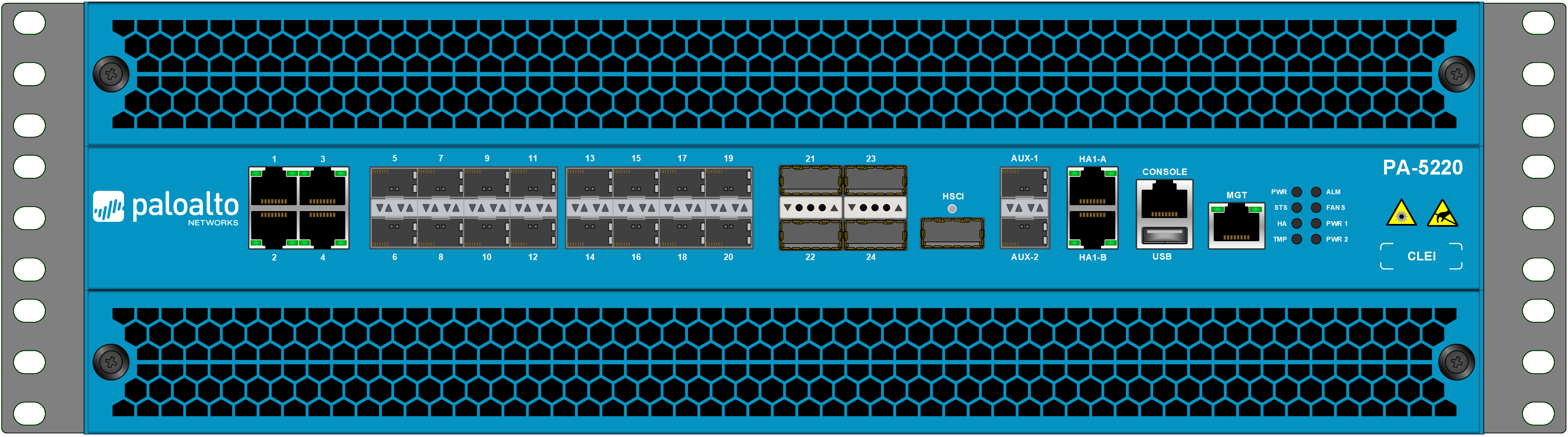
Palo Alto Networks PA-545-PoE
★ 3.5 Value Score
Technical Specifications
- Firewall Throughput: 5.1 Gbps App-ID (appmix). Reseller listings also show 5.0 Gbps; the official PA-500 datasheet was not retrievable to confirm
- Threat Prevention Throughput: 3.6 Gbps (reseller listings also show 3.0 Gbps; unverified)
- IPsec VPN Throughput: 2.5 Gbps (one reseller lists 3.0 Gbps; unverified)
- Max Sessions: 400K concurrent (one reseller lists 298K; unverified)
- New Sessions/sec: 72K (one reseller lists 55K; unverified)
- Interfaces: 8x RJ-45 10M/100M/1G copper (ports 1-8, ports 3-4 fail-open, port 1 ZTP); 4x RJ-45 mGig 1G/2.5G PoE+ (ports 9-12); 4x SFP 1G (ports 13-16, no 10G support); 1x RJ-45 1G management; 1x USB-C and 1x RJ-45 console; 1x USB admin/bootstrap port
- Form Factor: 1U rack-mountable (one reseller lists Desktop/1U; optional 1RU 4-post rack kit)
- PoE Budget: 181W total across ports 9-12, up to 90W per port (official Palo Alto electrical spec)
- Max Power Consumption: 336W (official Palo Alto electrical spec); 100-240V AC input, 54VDC adapter output, 6A @ 54VDC
- Layer: L2/L3 security appliance (Layer 7 NGFW)
- Power Redundancy: 2 DC inputs; one PSU required, second optional
- Virtual Systems: 1 base / 7 max (one listing shows 1/2)
- Price Source Note: Single reseller listing (Newegg, $5,475.00, marked out of stock). CDW shows a quote-only price. No official Palo Alto list price found
Curation Review
- ✔ Pros: Four mGig 2.5G PoE+ ports suit Wi-Fi 6/6E APs and cameras without a separate injector; Four SFP 1G ports allow fiber uplinks or fiber-to-copper flexibility; Dual DC power inputs with optional second PSU add power redundancy; Fail-open ports 3-4 keep pass-through connectivity during power or OS failure; Zero Touch Provisioning on port 1 simplifies branch deployment; Compact 1U footprint with full Palo Alto Networks NGFW feature set and PAN-OS
- ✘ Cons: No 10G port support; SFP ports are 1G only, which limits high-speed uplinks; Only four PoE ports and a 181W total PoE budget, versus 332W on the PA-555-POE; Performance figures conflict across reseller sources and the official datasheet could not be retrieved to confirm them; Pricing is quote-based at many resellers, with the one listed price showing out of stock; Licensing (Threat Prevention, URL, support subscriptions) adds recurring cost beyond the hardware price
- Est. Price: $5,475
Compare Against

Ubiquiti Enterprise Fortress Gateway (EFG)
★ 4.9 Value Score
Technical Specifications
- Firewall Throughput: 23.5 Gbps (routing, iPerf3, DHCP WAN)
- Threat Prevention Throughput: 12.5 Gbps (IDS/IPS)
- IPsec VPN Throughput: 580 Mbps (site-to-site, single tunnel)
- Max Sessions: 1,000,000 concurrent
- New Sessions/sec: 71,000 (listed under general capacity; not specific to VPN or IPsec)
- Interfaces: 2x 2.5GbE RJ45, 2x 25G SFP28, 2x 10G SFP+ (some listings show 2x RJ45 + 4x SFP28; verify against the Ubiquiti datasheet)
- Form Factor: 1U rack-mount, dual hot-swappable PSUs
- SSL/TLS Inspection Concurrent Sessions: 10,000 (5,000 recommended under heavy traffic)
- CPU / Memory: 18-core ARM v8.2 @ 2 GHz, 16 GB DDR4
- UniFi Capacity: 500+ UniFi devices, 5,000+ clients
Curation Review
- ✔ Pros: 25G SFP28 and 10G SFP+ uplinks at a gateway price point; 23.5 Gbps routing throughput; 1 million concurrent sessions; 18-core ARM CPU with 16 GB RAM; hot-swappable redundant PSUs; supports 500+ UniFi devices and 5,000+ clients; manages through UniFi Network controller with a single pane of glass
- ✘ Cons: IPsec VPN throughput of 580 Mbps is low for a gateway at this price; IDS/IPS throughput of 12.5 Gbps halves routing performance when threat inspection is enabled; SSL/TLS inspection is limited to about 10,000 concurrent sessions; port configuration differs across listings and should be verified; frequently out of stock at major US retailers, with a $170 memory surcharge at some resellers; no built-in Wi-Fi, so it depends on separate UniFi APs and switches; reviewers cite a steeper learning curve than consumer-grade routers
- Est. Price: $1,999 - $2,892
Popular Comparisons
Palo Alto Networks PA-545-PoE vs Ubiquiti UniFi Cloud Gateway Fiber
Palo Alto Networks PA-545-PoE vs Ubiquiti UniFi Dream Machine Pro Max
Palo Alto Networks PA-545-PoE vs Ubiquiti Cloud Gateway Max
Palo Alto Networks PA-545-PoE vs Ubiquiti UniFi Cloud Gateway Max (UCG-Max)
Palo Alto Networks PA-545-PoE vs Ubiquiti Enterprise Fortress Gateway (EFG)